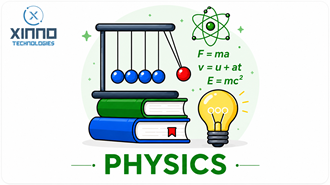
Intermediate 1 st Year Physics

- Description
- Curriculum
- FAQ
- Reviews
 To book a demo class, Click Here
SYLLABUS
Unit 1: Physical World
What is Physics – Scope and Excitement of Physics – Physics, Technology and Society – Fundamental Forces in Nature – Nature of Physical Laws.
Unit 2: Units and Measurements
SI System of Units – Measurement of Length, Mass and Time – Accuracy and Precision – Errors in Measurement – Significant Figures – Dimensions and Dimensional Analysis.
Unit 3: Motion in a Straight Line
Position, Path Length and Displacement – Average and Instantaneous Velocity – Acceleration – Equations of Motion – Relative Velocity.
Unit 4: Motion in a Plane
Scalars and Vectors – Vector Addition and Subtraction – Resolution of Vectors – Motion in a Plane – Projectile Motion – Uniform Circular Motion – Relative Velocity in Two Dimensions.
Unit 5: Laws of Motion
Aristotle’s Fallacy – Law of Inertia – Newton’s Laws of Motion – Conservation of Momentum – Equilibrium of a Particle – Friction – Circular Motion – Applications of Mechanics.
Unit 6: Work, Energy and Power
Work-Energy Theorem – Work Done by Variable Force – Kinetic and Potential Energy – Conservation of Mechanical Energy – Energy Conservation – Power – Collisions.
Unit 7: System of Particles and Rotational Motion
Centre of Mass – Motion of Centre of Mass – Linear Momentum – Angular Velocity – Torque – Angular Momentum – Equilibrium of Rigid Bodies – Moment of Inertia – Rolling Motion.
Unit 8: Oscillations
Periodic Motion – Simple Harmonic Motion – SHM and Circular Motion – Velocity and Acceleration in SHM – Energy in SHM – Damped Oscillations – Forced Oscillations and Resonance.
Unit 9: Gravitation
Kepler’s Laws – Universal Law of Gravitation – Gravitational Constant – Acceleration Due to Gravity – Escape Velocity – Satellites – Weightlessness.
Unit 10: Mechanical Properties of Solids
Elastic Behaviour – Stress and Strain – Hooke’s Law – Stress-Strain Curve – Elastic Moduli – Applications of Elasticity.
Unit 11: Mechanical Properties of Fluids
Pressure – Streamline Flow – Bernoulli’s Principle – Viscosity – Reynolds Number – Surface Tension.
Unit 12: Thermal Properties of Matter
Temperature and Heat – Measurement of Temperature – Ideal Gas Equation – Thermal Expansion – Specific Heat Capacity – Calorimetry – Change of State – Heat Transfer – Newton’s Law of Cooling.
Unit 13: Thermodynamics
Thermal Equilibrium – Zeroth Law – First Law of Thermodynamics – Thermodynamic Processes – Heat Engines – Refrigerators and Heat Pumps – Second Law of Thermodynamics – Carnot Engine and Carnot Theorem.
Unit 14: Kinetic Theory
Molecular Nature of Matter – Behaviour of Gases – Kinetic Theory of Ideal Gases – Law of Equipartition of Energy – Specific Heat Capacity – Mean Free Path.
• Grasping the underlying conceptual frameworks and derivations clearly, rather than relying on rote formula memorization.
• Developing systematic problem-solving steps and practicing numerical exercises regularly.
• Connecting abstract laws of physics to real-world phenomena to understand how things work.
• Maintaining a positive, persistent attitude when tackling complex, challenging problems.