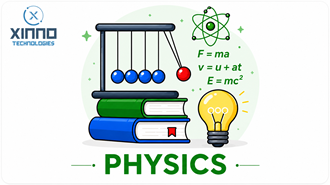
Intermediate 2nd Year Physics

- Description
- Curriculum
- FAQ
- Reviews
 To book a demo class, Click Here
SYLLABUS
Unit 1: Waves
Transverse and Longitudinal Waves – Progressive Waves – Wave Speed – Principle of Superposition – Reflection of Waves – Beats – Doppler Effect.
Unit 2: Ray Optics and Optical Instruments
Reflection by Spherical Mirrors – Refraction – Total Internal Reflection – Refraction Through Lenses and Prisms – Dispersion – Optical Phenomena Due to Sunlight – Optical Instruments.
Unit 3: Wave Optics
Huygens Principle – Reflection and Refraction Using Huygens Principle – Coherent and Incoherent Waves – Interference – Young’s Double Slit Experiment – Diffraction – Polarisation.
Unit 4: Electric Charges and Fields
Electric Charges – Conductors and Insulators – Charging by Induction – Coulomb’s Law – Electric Field – Electric Flux – Electric Dipole – Gauss’s Law and Applications.
Unit 5: Electrostatic Potential and Capacitance
Electrostatic Potential – Potential Due to Charges and Dipoles – Equipotential Surfaces – Potential Energy – Electrostatics of Conductors – Dielectrics – Capacitors – Combination of Capacitors – Energy Stored in Capacitors – Van de Graaff Generator.
Unit 6: Current Electricity
Electric Current – Ohm’s Law – Drift Velocity – Resistivity – Electric Power – Series and Parallel Resistors – Cells and Internal Resistance – Kirchhoff’s Laws – Wheatstone Bridge – Meter Bridge – Potentiometer.
Unit 7: Moving Charges and Magnetism
Magnetic Force – Motion in Magnetic Fields – Biot-Savart Law – Ampere’s Circuital Law – Solenoid and Toroid – Torque on Current Loop – Moving Coil Galvanometer.
Unit 8: Magnetism and Matter
Bar Magnet – Earth’s Magnetism – Magnetisation – Magnetic Intensity – Magnetic Properties of Materials – Electromagnets.
Unit 9: Electromagnetic Induction
Faraday’s Laws – Lenz’s Law – Motional EMF – Eddy Currents – Inductance – AC Generator.
Unit 10: Alternating Current
AC Through Resistor, Inductor and Capacitor – LCR Circuits – Power Factor – LC Oscillations – Transformers.
Unit 11: Electromagnetic Waves
Displacement Current – Electromagnetic Waves – Electromagnetic Spectrum.
Unit 12: Dual Nature of Radiation and Matter
Photoelectric Effect – Einstein’s Photoelectric Equation – Photon Concept – Wave Nature of Matter – Davisson-Germer Experiment.
Unit 13: Atoms
Rutherford Model – Atomic Spectra – Bohr Model – Hydrogen Spectrum – Quantisation of Angular Momentum.
Unit 14: Nuclei
Composition of Nucleus – Nuclear Size – Binding Energy – Nuclear Forces – Radioactivity – Nuclear Energy.
Unit 15: Semiconductor Electronics
Intrinsic and Extrinsic Semiconductors – p-n Junction – Diodes – Rectifiers – Junction Transistors – Logic Gates – Integrated Circuits.
Unit 16: Communication Systems
Elements of Communication Systems – Bandwidth – Propagation of Electromagnetic Waves – Modulation – Amplitude Modulation – Detection of Modulated Waves.
• Grasping the underlying conceptual frameworks and derivations clearly, rather than relying on rote formula memorization.
• Developing systematic problem-solving steps and practicing numerical exercises regularly.
• Connecting abstract laws of physics to real-world phenomena to understand how things work.
• Maintaining a positive, persistent attitude when tackling complex, challenging problems.