- Description
- Curriculum
- FAQ
- Reviews
 To book a demo class, Click Here
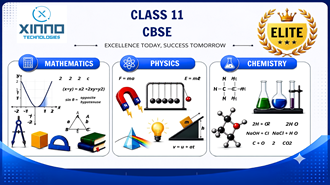
Subjects Covered: Mathematics, Physics and Chemistry
SYLLABUS
MATHEMATICS
Unit-I: Sets and Functions
1. Sets
Sets and their representations, Empty set, Finite and Infinite sets, Equal sets, Subsets, Subsets of a set of real numbers especially intervals (with notations). Universal set. Venn diagrams. Union and Intersection of sets. Difference of sets. Complement of a set. Properties of Complement.
2. Relations & Functions
Ordered pairs. Cartesian product of sets. Number of elements in the Cartesian product of two finite sets. Cartesian product of the set of reals with itself (up to R x R x R). Definition of relation, pictorial diagrams, domain, co-domain and range of a relation. Function as a special type of relation. Pictorial representation of a function, domain, co-domain and range of a function. Real valued functions, domain and range of these functions, constant, identity, polynomial, rational, modulus, signum, exponential, logarithmic and greatest integer functions, with their graphs. Sum, difference, product and quotients of functions.
3. Trigonometric Functions
Positive and negative angles. Measuring angles in radians and in degrees and conversion from one measure to another. Definition of trigonometric functions with the help of unit circle. Truth of the identity 𝑠𝑖𝑛2𝑥 + 𝑐𝑜𝑠2𝑥 = 1, for all x. Signs of trigonometric functions. Domain and range of trigonometric functions and their graphs. Expressing 𝑠𝑖𝑛 (𝑥±𝑦) and 𝑐𝑜𝑠 (𝑥±𝑦) in terms of 𝑠𝑖𝑛𝑥,𝑠𝑖𝑛𝑦,𝑐𝑜𝑠𝑥 & 𝑐𝑜𝑠𝑦 and their simple applications. Deducing identities. Identities related to sin 2𝑥 , cos 2𝑥 , tan 2𝑥 , sin 3𝑥 , cos 3𝑥 and tan 3𝑥.
Unit-II: Algebra
1. Complex Numbers and Quadratic Equations
Need for complex numbers, especially √−1, to be motivated by inability to solve some of the quadratic equations. Algebraic properties of complex numbers. Argand plane.
2. Linear Inequalities
Linear inequalities. Algebraic solutions of linear inequalities in one variable and their representation on the number line.
3. Permutations and Combinations
Fundamental principle of counting. Factorial n. (n!) Permutations and combinations, derivation of Formulae for nPr, nCr and their connections, simple applications.
4. Binomial Theorem
Historical perspective, statement and proof of the binomial theorem for positive integral indices. Pascal’s triangle, simple applications.
5. Sequence and Series
Sequence and Series. Arithmetic Mean (A.M.) Geometric Progression (G.P.), general term of a G.P., sum of n terms of a G.P., infinite G.P. and its sum, geometric mean (G.M.), relation between A.M. and G.M
Unit-III: Coordinate Geometry
1. Straight Lines
Brief recall of two-dimensional geometry from earlier classes. Slope of a line and angle between two lines. Various forms of equations of a line: parallel to axis, point -slope form, slope-intercept form, two-point form, intercept form. Distance of a point from a line.
2. Conic Sections
Sections of a cone: circles, ellipse, parabola, hyperbola, a point, a straight line and a pair of intersecting lines as a degenerated case of a conic section. Standard equations and simple properties of parabola, ellipse and hyperbola. Standard equation of a circle.
3. Introduction to Three-dimensional Geometry
Coordinate axes and coordinate planes in three dimensions. Coordinates of a point. Distance between two points.
Unit-IV: Calculus
1. Limits and Derivatives
Derivative introduced as rate of change both as that of distance function and geometrically. Intuitive idea of limit. Limits of polynomials and rational functions trigonometric, exponential and logarithmic functions. Definition of derivative relate it to scope of tangent of the curve, derivative of sum, difference, product and quotient of functions of polynomial and trigonometric functions.
Unit-V Statistics and Probability
1. Statistics
Measures of Dispersion: Range, Mean deviation, variance and standard deviation of ungrouped/grouped data.
2. Probability
Events; occurrence of events, ‘not’, ‘and’ and ‘or’ events, exhaustive events, mutually exclusive events, Axiomatic (set theoretic) probability, connections with other theories of earlier classes. Probability of an event, probability of ‘not’, ‘and’ and ‘or’ events.
PHYSICS
UNIT I: PHYSICAL WORLD AND MEASUREMENT
Need for Measurement – Units of Measurement – Systems of Units – SI Units – Fundamental and Derived Units – Significant Figures – Determining the Uncertainty in Result – Dimensions of Physical Quantities – Dimensional Analysis and its Applications.
UNIT II: KINEMATICS
Chapter–2: Motion in a Straight Line
Frame of Reference – Motion in a Straight Line – Elementary Concepts of Differentiation and Integration for Describing Motion – Uniform and Non-uniform Motion – Average Speed and Average Velocity – Instantaneous Velocity – Uniformly Accelerated Motion – Velocity-Time Graphs – Position-Time Graphs – Relations for Uniformly Accelerated Motion (Graphical and Calculus Treatment).
Chapter–3: Motion in a Plane
Scalar and Vector Quantities – Position and Displacement Vectors – General Vectors and their Notations – Equality of Vectors – Multiplication of Vectors by a Real Number – Addition and Subtraction of Vectors – Unit Vector – Resolution of a Vector in a Plane – Rectangular Components – Scalar Product of Vectors – Vector Product of Vectors – Motion in a Plane – Cases of Uniform Velocity and Uniform Acceleration – Projectile Motion – Uniform Circular Motion.
UNIT III: LAWS OF MOTION
Chapter–4: Laws of Motion
Intuitive Concept of Force – Inertia – Newton’s First Law of Motion – Momentum – Newton’s Second Law of Motion – Impulse – Newton’s Third Law of Motion – Law of Conservation of Linear Momentum and its Applications – Equilibrium of Concurrent Forces – Static Friction – Kinetic Friction – Laws of Friction – Rolling Friction – Lubrication – Dynamics of Uniform Circular Motion – Centripetal Force – Examples of Circular Motion (Vehicle on a Level Circular Road, Vehicle on a Banked Road).
UNIT IV: WORK, ENERGY AND POWER
Chapter–5: Work, Energy and Power
Work Done by a Constant Force and a Variable Force – Kinetic Energy – Work-Energy Theorem – Power – Notion of Potential Energy – Potential Energy of a Spring – Conservative Forces – Non-Conservative Forces – Motion in a Vertical Circle – Elastic and Inelastic Collisions in One and Two Dimensions.
UNIT V: MOTION OF SYSTEM OF PARTICLES AND RIGID BODY
Chapter–6: System of Particles and Rotational Motion
Centre of Mass of a Two-Particle System – Momentum Conservation and Centre of Mass Motion – Centre of Mass of a Rigid Body – Centre of Mass of a Uniform Rod – Moment of a Force – Torque – Angular Momentum – Law of Conservation of Angular Momentum and its Applications – Equilibrium of Rigid Bodies – Rigid Body Rotation – Equations of Rotational Motion – Comparison of Linear and Rotational Motions – Moment of Inertia – Radius of Gyration – Values of Moments of Inertia for Simple Geometrical Objects (No Derivation).
UNIT VI: GRAVITATION
Chapter–7: Gravitation
Kepler’s Laws of Planetary Motion – Universal Law of Gravitation – Acceleration due to Gravity and its Variation with Altitude and Depth – Gravitational Potential Energy – Gravitational Potential – Escape Speed – Orbital Velocity of a Satellite – Energy of an Orbiting Satellite.
UNIT VII: PROPERTIES OF BULK MATTER
Chapter–8: Mechanical Properties of Solids
Elasticity – Stress-Strain Relationship – Hooke’s Law – Young’s Modulus – Bulk Modulus – Shear Modulus of Rigidity (Qualitative Idea Only) – Poisson’s Ratio – Elastic Energy – Application of Elastic Behaviour of Materials (Qualitative Idea Only).
Chapter–9: Mechanical Properties of Fluids
Pressure Due to a Fluid Column – Pascal’s Law and its Applications (Hydraulic Lift and Hydraulic Brakes) – Effect of Gravity on Fluid Pressure – Viscosity – Stokes’ Law – Terminal Velocity – Streamline Flow – Turbulent Flow – Critical Velocity – Bernoulli’s Theorem and its Simple Applications (Torricelli’s Law and Dynamic Lift) – Surface Energy – Surface Tension – Angle of Contact – Excess Pressure Across a Curved Surface – Applications of Surface Tension to Drops, Bubbles and Capillary Rise.
Chapter–10: Thermal Properties of Matter
Heat – Temperature – Thermal Expansion – Thermal Expansion of Solids, Liquids and Gases – Anomalous Expansion of Water – Specific Heat Capacity – Cp and Cv – Calorimetry – Change of State – Latent Heat Capacity – Heat Transfer by Conduction, Convection and Radiation – Thermal Conductivity – Qualitative Ideas of Blackbody Radiation – Wien’s Displacement Law – Stefan’s Law.
UNIT VIII: THERMODYNAMICS
Chapter–11: Thermodynamics
Thermal Equilibrium and Definition of Temperature – Zeroth Law of Thermodynamics – Heat – Work and Internal Energy – First Law of Thermodynamics – Second Law of Thermodynamics – Thermodynamic State Variables – Equation of State – Change of Condition of Gaseous State – Isothermal Process – Adiabatic Process – Reversible Process – Irreversible Process – Cyclic Process.
UNIT IX: BEHAVIOUR OF PERFECT GASES AND KINETIC THEORY OF GASES
Chapter–12: Kinetic Theory
Equation of State of a Perfect Gas – Work Done in Compressing a Gas – Kinetic Theory of Gases – Assumptions of Kinetic Theory – Concept of Pressure – Kinetic Interpretation of Temperature – RMS Speed of Gas Molecules – Degrees of Freedom – Law of Equi-partition of Energy (Statement Only) – Application to Specific Heat Capacities of Gases – Concept of Mean Free Path – Avogadro’s Number.
UNIT X: OSCILLATIONS AND WAVES
Chapter–13: Oscillations
Periodic Motion – Time Period – Frequency – Displacement as a Function of Time – Periodic Functions and their Applications – Simple Harmonic Motion (SHM) – Uniform Circular Motion and its Equations of Motion – Phase – Oscillations of a Loaded Spring – Restoring Force and Force Constant – Energy in SHM – Kinetic Energy and Potential Energy – Simple Pendulum – Derivation of Expression for Time Period.
Chapter–14: Waves
Wave Motion – Transverse Waves – Longitudinal Waves – Speed of Travelling Wave – Displacement Relation for a Progressive Wave – Principle of Superposition of Waves – Reflection of Waves – Standing Waves in Strings and Organ Pipes – Fundamental Mode and Harmonics – Beats.
CHEMISTRY
Unit 1: Some Basic Concepts of Chemistry
Importance of Chemistry – Nature of Matter – Properties of Matter and their Measurement – Uncertainty in Measurement – Laws of Chemical Combination – Dalton’s Atomic Theory – Atomic and Molecular Masses – Mole Concept and Molar Masses – Percentage Composition – Stoichiometry – Stoichiometric Calculations.
Unit 2: Structure of Atom
Discovery of Sub-atomic Particles – Atomic Models – Developments Leading to the Bohr’s Model of Atom – Bohr’s Model for Hydrogen Atom – Towards Quantum Mechanical Model of the Atom – Quantum Mechanical Model of Atom.
Unit 3: Classification of Elements and Periodicity in Properties
Why we Need to Classify Elements? – Genesis of Periodic Classification – Modern Periodic Law and the Present Form of Periodic Table – Nomenclature of Elements with Atomic Number > 100 – Electronic Configuration of Elements and the Periodic Table – Electronic Configuration of Elements and Types of Elements: s-, p-, d-, f- Blocks – Periodic Trends in Properties of Elements.
Unit 4: Chemical Bonding and Molecular Structure
Kossel-Lewis Approach to Chemical Bonding – Ionic or Electrovalent Bond – Bond Parameters – The Valence Shell Electron Pair Repulsion (VSEPR) Theory – Valence Bond Theory – Hybridisation – Molecular Orbital Theory – Bonding in Some Homonuclear Diatomic Molecules – Hydrogen Bonding.
Unit 5: Chemical Thermodynamics
Thermodynamic Terms – Applications – Measurement of ΔU and ΔH: Calorimetry – Enthalpy Change – ΔH of a Reaction – Reaction Enthalpy – Enthalpies for Different Types of Reactions – Spontaneity – Gibbs Energy Change – Equilibrium.
Unit 6: Equilibrium
Equilibrium in Physical Processes – Equilibrium in Chemical Processes: Dynamic Equilibrium – Law of Chemical Equilibrium and Equilibrium Constant – Homogeneous Equilibria – Heterogeneous Equilibria – Applications of Equilibrium Constants – Relationship between Equilibrium Constant K, Reaction Quotient Q and Gibbs Energy G – Factors Affecting Equilibria – Ionic Equilibrium in Solution – Acids – Bases and Salts – Ionization of Acids and Bases – Buffer Solutions – Solubility Equilibria of Sparingly Soluble Salts.
Unit 7: Redox Reactions
Classical Idea of Redox Reactions – Oxidation and Reduction Reactions – Redox Reactions in Terms of Electron Transfer Reactions – Oxidation Number – Redox Reactions and Electrode Processes.
Unit 8: Organic Chemistry – Some Basic Principles and Techniques
General Introduction – Tetravalence of Carbon: Shapes of Organic Compounds – Structural Representations of Organic Compounds – Classification of Organic Compounds – Nomenclature of Organic Compounds – Isomerism – Fundamental Concepts in Organic Reaction Mechanism – Methods of Purification of Organic Compounds – Qualitative Analysis of Organic Compounds – Quantitative Analysis.
Unit 9: Hydrocarbons
Classification – Alkanes – Alkenes – Alkynes – Aromatic Hydrocarbon – Carcinogenic and Toxicity.

Understanding concepts thoroughly instead of memorizing formulas.
Practicing numerical problems, worksheets, and assignments regularly.
Solving previous year question papers and mock tests.
Developing logical thinking and analytical problem-solving skills.
Relating theoretical concepts to practical and real-world applications.
Revising important topics consistently.
Maintaining a positive attitude and disciplined study routine.
Building confidence through personalized guidance.
Encouraging curiosity and critical thinking.
Focusing on conceptual understanding rather than rote learning.
Conducting interactive classroom sessions.
Providing regular assignments and practice exercises.
Conducting weekly tests and performance evaluations.
Offering timely doubt-clearing support.
Helping students develop strong analytical and problem-solving abilities.
Elite
FEATURES
📚 Class
- Live Interactive Classes by Expert Faculty
- Live Discussion of Practice Questions
- Live In-Class Doubt Solving
- Live Quizzes & Performance Leaderboard
- Classroom-Like Learning Experience
- Very Small Batch Size for Better Attention
📖 After Class
- Assignments & Class Notes
- Weekly/Monthly Test Series
- Digital Study Material
- Post-Class Doubt Support
- Student Progress Reports
- Parent Portal Access
- Parent-Teacher Meetings
- Handwritten Faculty Notes
- Chapter-wise Tests
- Unlimited Practice Worksheets
- Mock Tests with Discussion
- Career Guidance Sessions
⭐ Premium Benefits
- Dedicated Personal Mentor
- One-on-One Doubt Solving Sessions
- Personalized Study Plan
- Individual Performance Analysis
- Monthly Parent Counselling
- Priority Doubt Resolution
- Exam Strategy Sessions
- Motivation & Mentorship Support
🌟 Value Adds
- Genesis Benefits Included
- Dedicated Personal Mentor
- Personalized Academic Guidance
- Priority Student Support
- Higher Success Tracking