- Description
- Curriculum
- FAQ
- Reviews
 To book a demo class, Click Here
Subjects Covered: Mathematics, Science and English
SYLLABUS
MATHEMATICS
Unit–1: Number System
Numbers and Whole Numbers – Place value – Large numbers – Properties of whole numbers – BODMAS operations – Negative numbers – Integers – Number line – Arithmetic operations on integers.
Unit–2: Fractions and Decimals
Types of fractions – Equivalent fractions – Conversion of fractions – Operations on fractions – Decimal representation – Conversion between fractions and decimals.
Unit–3: Playing with Numbers
Factors – Multiples – Prime numbers – Composite numbers – Co-prime numbers – Divisibility tests – HCF – LCM.
Unit–4: Ratio and Proportion
Concept of ratio – Comparison of quantities – Equivalent ratios – Proportion – Unitary method.
Unit–5: Commercial Mathematics
Percentage – Profit and loss – Introduction to simple interest – Speed – Distance – Time.
Unit–6: Algebra
Constants – Variables – Algebraic terms – Coefficients – Algebraic expressions – Simple linear equations in one variable.
Unit–7: Geometry
Points – Lines – Line segments – Rays – Angles – Types of angles – Triangles – Quadrilaterals – Polygons – Circle and its parts.
Unit–8: Symmetry and Constructions
Line symmetry – Reflection – Construction of line segments – Construction of angles using compass.
Unit–9: Mensuration
Perimeter of rectangles and squares – Area of rectangles and squares – Volume of cubes and cuboids.
Unit–10: Data Handling and Sets
Collection of data – Organisation of data – Pictographs – Bar graphs – Interpretation of data – Concept of sets – Representation of sets – Empty set – Finite set.
SCIENCE
Unit–1: Living Things and Their Environment
Characteristics of living things – Growth – Movement – Respiration – Reproduction – Response to stimuli – Living and non-living things – Habitat – Adaptations – Interaction with environment.
Unit–2: Plant Life
Parts of a plant – Root – Stem – Leaf – Flower – Functions of each part – Types of roots – Modifications of roots – Types of stems – Modifications of stems – Photosynthesis – Transpiration – Reproduction in plants.
Unit–3: Animal Life
Classification of animals – Vertebrates and invertebrates – Habitat of animals – Adaptations in animals – Food habits – Movement in animals – Life processes.
Unit–4: Food and Health
Food and its importance – Nutrients – Carbohydrates – Proteins – Fats – Vitamins – Minerals – Balanced diet – Deficiency diseases – Healthy eating habits.
Unit–5: Human Body and Health
Human body systems – Digestive system – Respiratory system – Circulatory system – Skeletal system – Personal hygiene – Health and sanitation.
Unit–6: Matter and Materials
Matter – States of matter – Solids – Liquids – Gases – Properties of materials – Changes in matter – Physical and chemical changes.
Unit–7: Force and Energy
Force – Types of force – Effects of force – Energy – Forms of energy – Sources of energy – Conservation of energy.
Unit–8: Air and Water
Composition of air – Importance of air – Water and its sources – Water cycle – Uses of water – Conservation of water – Air and water pollution.
Unit–9: Environment and Conservation
Natural resources – Ecosystem – Environmental pollution – Conservation of resources – Sustainable use of resources.
ENGLISH
Unit–1: Reading Comprehension
Unseen prose passages – Unseen poems – Factual questions – Inferential questions – Vocabulary-based questions.
Unit–2: Composition Writing
Narrative writing – Descriptive writing – Imaginative writing – Structured essays – Picture composition.
Unit–3: Letter Writing
Informal letters – Personal experiences – Invitations – Descriptions.
Unit–4: Grammar
Subject and Predicate – Types of sentences – Nouns – Pronouns – Adjectives – Degrees of comparison – Verbs – Tenses – Adverbs – Prepositions – Conjunctions.
English Literature
Unit–1: Prose and Drama
Adventure themes – Family values – Humour – Folklore – Historical legends – Character analysis – Contextual meaning – Plot analysis.
Unit–2: Poetry Appreciation
Themes – Central message – Simile – Metaphor – Personification – Rhyme scheme.
Reading and revising lessons regularly.
Understanding concepts instead of memorizing.
Practicing worksheets, assignments, and sample papers.
Strengthening grammar, vocabulary, formulas, and scientific concepts.
Solving additional practice questions.
Asking doubts whenever needed.
Maintaining consistency and a positive attitude toward learning.
Building confidence and motivation.
Encouraging questions and curiosity.
Focusing on conceptual understanding rather than rote learning.
Providing interactive classroom sessions.
Giving regular assignments and practice exercises.
Conducting tests and performance evaluations.
Offering timely doubt-clearing support.
Helping students develop analytical and problem-solving skills.
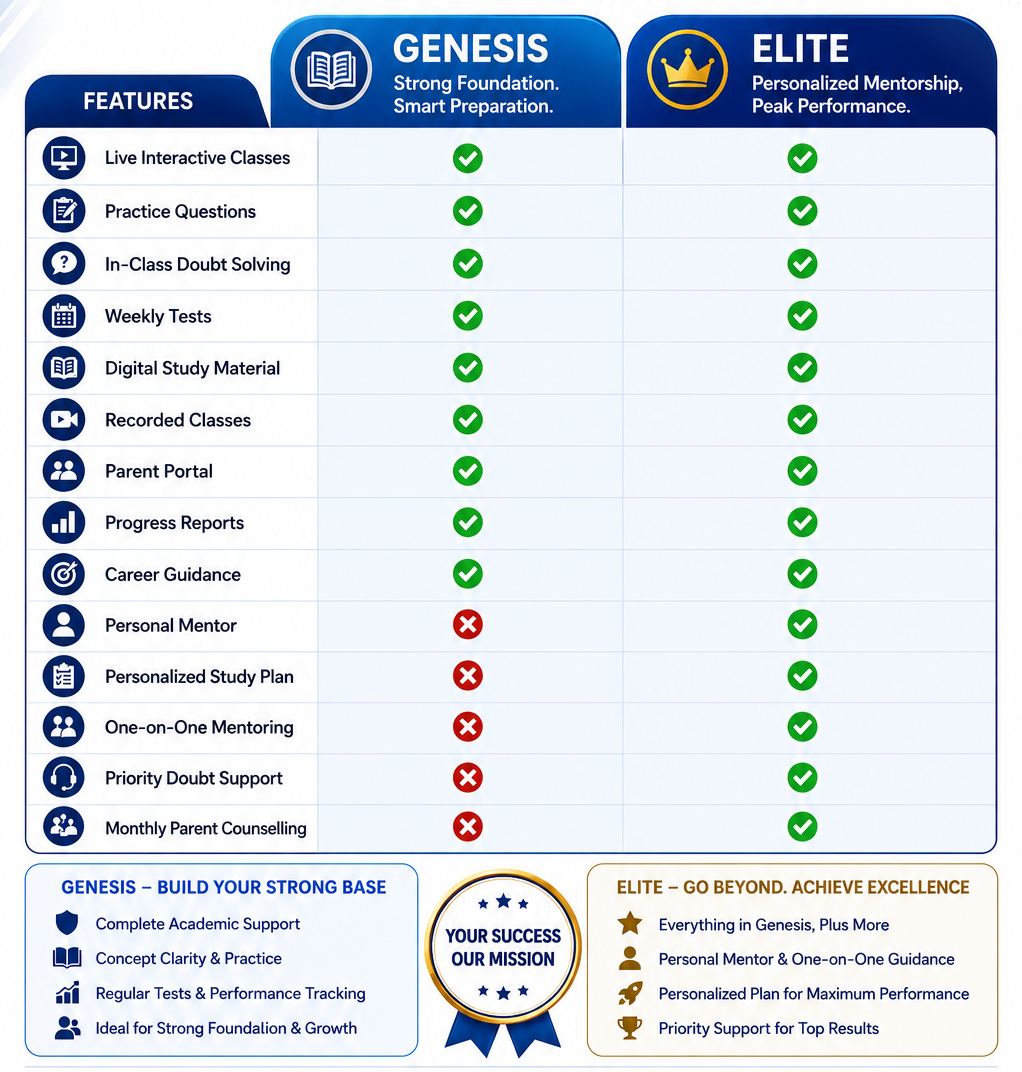
Genesis
FEATURES
📚 Class
- Live Interactive Classes by Expert Faculty
- Live Discussion of Practice Questions
- Live In-Class Doubt Solving
- Live Quizzes & Performance Leaderboard
- Classroom-Like Learning Experience
- Small Batch Size for Better Attention
After Class
- Assignments & Class Notes
- Weekly/Monthly Test Series
- Digital Study Material
- Post-Class Doubt Support
- Student Progress Reports
- Parent Portal Access
- Parent-Teacher Meetings
- Handwritten Faculty Notes
- Chapter-wise Tests
- Unlimited Practice Worksheets
- Mock Tests with Discussion
- Career Guidance Sessions
🌟 Value Adds
- Personalized Learning Experience
- Regular Performance Tracking
- Free Career Guidance