- Description
- Curriculum
- FAQ
- Reviews
 To book a demo class, Click Here
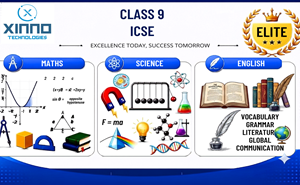
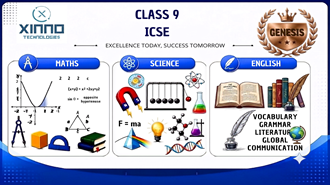
Subjects Covered: Mathematics, Science and English
SYLLABUS
MATHEMATICS
Unit–1: Number System
Rational numbers – Irrational numbers – Real numbers – Properties and applications.
Unit–2: Algebra
Algebraic identities – Factorisation – Simultaneous linear equations – Graphical solutions – Word problems – Indices – Exponents – Logarithms.
Unit–3: Geometry
Congruency of triangles – Isosceles triangles – Inequalities in triangles – Mid-point theorem – Pythagoras theorem – Parallelograms – Quadrilaterals.
Unit–4: Coordinate Geometry
Cartesian coordinate system – Plotting points – Distance formula.
Unit–5: Mensuration
Area and perimeter of plane figures – Surface area of solids – Volume of cubes – Volume of cuboids.
Unit–6: Statistics
Tabulation of data – Frequency polygons – Histograms – Mean – Median.
SCIENCE
Unit–1: Measurements and Experimentation
SI units – Least count – Vernier calipers – Screw gauge – Simple pendulum – Experimental techniques.
Unit–2: Motion in One Dimension
Scalar quantities – Vector quantities – Speed – Velocity – Acceleration – Equations of motion.
Unit–3: Laws of Motion
Force – Contact forces – Non-contact forces – Newton’s laws of motion – Inertia – Momentum.
Unit–4: Fluids
Thrust – Pressure – Archimedes’ principle – Relative density – Atmospheric pressure.
Unit–5: Heat and Energy
Temperature – Expansion of water – Energy resources – Global warming – Heat concepts.
Unit–6: Light and Sound
Reflection of light – Plane mirrors – Spherical mirrors – Ray diagrams – Sound production – Propagation of sound – Speed of sound.
Unit–7: Electricity and Magnetism
Electric circuits – Static electricity – Magnetism – Induced magnetism.
Science (Chemistry)
Unit–1: Language of Chemistry
Symbols – Valency – Chemical formulae – Balancing equations – Relative molecular mass.
Unit–2: Chemical Changes and Reactions
Synthesis reactions – Decomposition reactions – Displacement reactions – Double displacement reactions – Energy transformations.
Unit–3: Water
Properties of water – Hard water – Soft water – Hydrated crystals – Drying agents.
Unit–4: Atomic Structure and Bonding
Subatomic particles – Atomic number – Mass number – Isotopes – Octet rule – Electrovalent bonding – Covalent bonding.
Unit–5: Periodic Table
Modern periodic law – Groups 1, 2, 16, 17 and 18 – Periodic trends.
Unit–6: Hydrogen
Preparation of hydrogen – Properties of hydrogen – Oxidation and reduction.
Unit–7: Environmental Chemistry
Atmospheric pollution – Acid rain – Greenhouse effect – Ozone depletion.
Science (Biology)
Unit–1: Basic Biology
Cell – Unit of life – Plant tissues – Animal tissues.
Unit–2: Flowering Plants
Root – Stem – Leaf – Flower – Pollination – Fertilisation.
Unit–3: Plant Physiology
Seed structure – Germination – Growth and development in plants.
Unit–4: Diversity in Living Organisms
Five kingdom classification – Bacteria – Fungi – Economic importance.
Unit–5: Human Anatomy and Physiology
Nutrition – Digestion – Skeleton system – Movement and locomotion – Skin – Respiratory system.
Unit–6: Health, Hygiene and Waste Management
Communicable diseases – WHO – Red Cross – Waste management – Safe disposal methods
ENGLISH
Unit–1: Composition Writing
Narrative composition – Descriptive composition – Argumentative composition – Short story writing – Picture composition.
Unit–2: Letter Writing
Formal letters – Informal letters – Structured formats – Drafting and presentation.
Unit–3: Notice and Email Writing
Notice writing – Email writing – Layout – Drafting – Communication skills.
Unit–4: Comprehension and Grammar
Unseen passage comprehension – Vocabulary development – Precis writing – Prepositions – Tenses – Active voice – Passive voice – Direct speech – Indirect speech – Synthesis of sentences.
English Literature
Unit–1: Drama
Julius Caesar (Acts I & II) – Plot development – Character analysis – Themes – Important scenes.
Unit–2: Poetry
The Night Mail – Skimbleshanks: The Railway Cat – I Remember, I Remember – A Doctor’s Journal Entry – The Cold Within – Theme analysis – Literary devices – Appreciation.
Unit–3: Short Stories
Oliver Asks for More – The Model Millionaire – The Home-Coming – The Boy Who Broke the Bank – A Face in the Dark – Character analysis – Plot interpretation – Theme study.
Reading and revising lessons regularly.
Understanding concepts instead of memorizing.
Practicing worksheets, assignments, and sample papers.
Strengthening grammar, vocabulary, formulas, and scientific concepts.
Solving additional practice questions.
Asking doubts whenever needed.
Maintaining consistency and a positive attitude toward learning.
Building confidence and motivation.
Encouraging questions and curiosity.
Focusing on conceptual understanding rather than rote learning.
Providing interactive classroom sessions.
Giving regular assignments and practice exercises.
Conducting tests and performance evaluations.
Offering timely doubt-clearing support.
Helping students develop analytical and problem-solving skills.