EAPCET (TG) - Genesis

- Description
- Curriculum
- FAQ
- Reviews
 To book a demo class, Click Here
Mathematics
Unit 1 – Algebra
Functions – Ordered pairs – Types of functions – Definitions – Inverse functions and theorems – Domain – Range – Inverse of real valued functions – Mathematical induction – Principle of mathematical induction – Applications – Problems on divisibility – Matrices – Types of matrices – Scalar multiple of a matrix – Multiplication of matrices – Transpose of a matrix – Determinants – Adjoint and inverse of a matrix – Consistency and inconsistency of simultaneous equations – Rank of a matrix – Solution of simultaneous linear equations – Complex numbers as ordered pairs of real numbers – Fundamental operations – Representation in a + ib form – Modulus and amplitude – Geometrical and polar representation – Argand plane – De Moivre’s theorem – Integral and rational indices – nth roots of unity – Geometrical interpretations – Quadratic expressions – Quadratic equations in one variable – Sign of quadratic expressions – Change in signs – Maximum and minimum values – Quadratic inequalities – Theory of equations – Relation between roots and coefficients – Equations with connected roots – Equations with real coefficients – Complex conjugate roots – Transformation of equations – Reciprocal equations – Permutations and combinations – Fundamental principle of counting – Linear and circular permutations – Permutations of n dissimilar things taken r at a time – Permutations with repetitions – Combinations – Binomial theorem for positive integral index – Binomial theorem for rational index – Approximations using binomial theorem – Partial fractions – Rational fractions – Partial fractions involving repeated and non-repeated linear factors – Irreducible factors.
Unit 2 – Trigonometry
Trigonometric ratios – Variations – Graphs and periodicity – Compound angles – Multiple and sub-multiple angles – Sum and product transformations – Trigonometric equations – General solutions – Simple trigonometric equations – Inverse trigonometric functions – Reduction into bijective functions – Graphs of inverse trigonometric functions – Properties of inverse trigonometric functions – Hyperbolic functions – Definition – Graphs – Inverse hyperbolic functions – Graphs – Addition formulae – Properties of triangles – Relation between sides and angles – Sine rule – Cosine rule – Tangent rule – Projection rule – Half-angle formulae – Area of a triangle – Incircle and excircle.
Unit 3 – Vector Algebra
Vectors as triads of real numbers – Basic concepts – Types of vectors – Addition of vectors – Scalar multiplication – Angle between vectors – Linear combination of vectors – Components of vectors in three dimensions – Vector equations of line and plane – Scalar (dot) product – Geometrical interpretation – Orthogonal projections – Properties of dot product – Expression in i, j, k system – Angle between vectors – Vector methods – Vector equation of plane in normal form – Angle between planes – Vector (cross) product – Properties – Expression in i, j, k system – Vector areas – Scalar triple product – Different forms of vector equation of plane – Skew lines – Shortest distance – Coplanarity – Vector triple product.
Unit 4 – Probability
Measures of dispersion – Range – Mean deviation – Variance – Standard deviation of grouped and ungrouped data – Coefficient of variation – Analysis of frequency distributions – Probability – Random experiments and events – Classical definition – Axiomatic approach – Addition theorem – Independent and dependent events – Conditional probability – Multiplication theorem – Bayes theorem – Random variables – Probability distributions – Binomial distribution – Poisson distribution.
Unit 5 – Coordinate Geometry
Locus – Definition – Illustrations – Equations of locus – Problems on locus – Transformation of axes – Rules and derivations – Rotation of axes – Straight line – Normal form – Symmetric form – Reduction into various forms – Intersection of two lines – Family of lines – Concurrent lines – Condition for concurrency – Angle between lines – Length of perpendicular from a point to a line – Distance between parallel lines – Properties related to triangles – Pair of straight lines – Equations passing through origin – Angle between pair of lines – Conditions for perpendicular and coincident lines – Bisectors of angles – Pair of bisectors – General second-degree equation – Parallel lines – Distance between lines – Point of intersection – Homogenization – Circle – Standard equation – Centre and radius – Position of a point – Tangent – Chord of contact – Polar – Relative position of circles – System of circles – Radical axis – Angle between intersecting circles – Parabola – Conic sections – Tangent and normal – Ellipse – Standard equation – Parametric equations – Tangent and normal – Hyperbola – Standard equation – Parametric equations – Tangent and normal – Three-dimensional coordinates – Section formulae – Direction cosines – Direction ratios – Cartesian equation of plane.
Unit 6 – Calculus
Limits and continuity – Intervals and neighbourhoods – Limits – Standard limits – Continuity – Differentiation – Derivative of a function – Elementary properties – Trigonometric functions – Inverse trigonometric functions – Hyperbolic functions – Inverse hyperbolic functions – Methods of differentiation – Second-order derivatives – Applications of derivatives – Errors and approximations – Geometrical interpretation – Tangents and normals – Lengths of tangent, normal, subtangent and subnormal – Angle between curves – Orthogonality – Rate of change – Rolle’s theorem – Lagrange’s mean value theorem – Increasing and decreasing functions – Maxima and minima – Integration – Inverse process of differentiation – Standard forms – Properties of integrals – Substitution method – Integration of algebraic, exponential, logarithmic, trigonometric and inverse trigonometric functions – Integration by parts – Partial fractions – Reduction formulae – Definite integrals – Definite integral as limit of sum – Area interpretation – Fundamental theorem of integral calculus – Properties – Reduction formulae – Applications to areas – Differential equations – Formation of differential equations – Degree and order – Variable separable method – Homogeneous differential equations – Non-homogeneous differential equations – Linear differential equations.
Chemistry
Unit 1 – Atomic Structure
Introduction – Subatomic particles – Thomson’s model – Rutherford nuclear model – Drawbacks of Rutherford model – Bohr’s model – Electromagnetic radiation – Planck’s quantum theory – Hydrogen spectrum – Limitations of Bohr’s model – Dual nature of matter – Heisenberg uncertainty principle – Quantum mechanical model – Orbitals and quantum numbers – Shapes and energies of orbitals – Aufbau principle – Pauli exclusion principle – Hund’s rule – Electronic configuration – Stability of half-filled and fully-filled orbitals.
Unit 2 – Classification of Elements and Periodicity in Properties
Need for classification – Genesis of periodic classification – Modern periodic law – Periodic table – Nomenclature of elements – Electronic configuration and periodic table – s, p, d and f blocks – Atomic radius – Ionic radius – Ionization enthalpy – Electron gain enthalpy – Electronegativity – Oxidation states – Diagonal relationship – Anomalous properties of second period elements – Periodic trends and chemical reactivity.
Unit 3 – Chemical Bonding and Molecular Structure
Kossel-Lewis approach – Octet rule – Ionic bond – Lattice enthalpy – Covalent bond – Bond parameters – Bond length – Bond angle – Bond enthalpy – Bond order – Resonance – Dipole moment – VSEPR theory – Molecular geometry – Valence bond theory – Orbital overlap – Sigma and pi bonds – Hybridization – Coordinate bond – Molecular orbital theory – LCAO – Energy level diagrams – Bonding in homonuclear molecules – Hydrogen bonding – Intermolecular and intramolecular hydrogen bonding.
Unit 4 – States of Matter: Gases and Liquids
Intermolecular forces – Thermal energy – Gas laws – Ideal gas equation – Graham’s law of diffusion – Dalton’s law of partial pressures – Kinetic theory of gases – Kinetic gas equation – Molecular speed distribution – RMS velocity – Real gases – Compressibility factor – Liquefaction of gases – Properties of liquids – Vapour pressure – Viscosity – Surface tension.
Unit 5 – Stoichiometry
Basic concepts – Significant figures – Dimensional analysis – Laws of chemical combination – Conservation of mass – Definite proportions – Multiple proportions – Gay Lussac’s law – Dalton’s atomic theory – Avogadro’s law – Atomic and molecular masses – Mole concept – Equivalent weight – Percentage composition – Empirical formula – Molecular formula – Concentration terms – Molarity – Molality – Normality – Mole fraction – Redox reactions – Oxidation number – Balancing redox equations – Titrimetry.
Unit 6 – Thermodynamics
System and surroundings – Types of systems – State functions – Internal energy – Work and heat – First law of thermodynamics – Enthalpy – Heat capacity – Calorimetry – Enthalpy changes – Thermochemical equations – Hess’s law – Enthalpy of combustion – Atomization – Bond enthalpy – Solution enthalpy – Entropy – Second law of thermodynamics – Gibbs free energy – Spontaneity – Third law of thermodynamics.
Unit 7 – Chemical Equilibrium and Acids-Bases
Physical equilibrium – Chemical equilibrium – Dynamic equilibrium – Law of mass action – Equilibrium constant – Homogeneous equilibrium – Heterogeneous equilibrium – Le Chatelier’s principle – Ionic equilibrium – Acids and bases – Arrhenius theory – Bronsted-Lowry theory – Lewis theory – Ionization constants – pH scale – Common ion effect – Hydrolysis of salts – Buffer solutions – Solubility product – Solubility equilibria.
Unit 8 – Hydrogen and Its Compounds
Position of hydrogen – Isotopes – Preparation and properties of hydrogen – Hydrides – Water – Structure and properties of water – Hard and soft water – Hydrogen peroxide – Preparation and properties – Heavy water – Hydrogen as fuel.
Unit 9 – s-Block Elements
Alkali metals – Electronic configuration – Atomic and ionic radii – Ionization enthalpy – Hydration enthalpy – Physical and chemical properties – Oxides – Halides – Salts of oxo acids – Lithium and its anomalous behaviour – Sodium compounds – Sodium carbonate – Sodium chloride – Sodium hydroxide – Sodium bicarbonate – Biological importance – Alkaline earth metals – Beryllium anomaly – Calcium compounds – Calcium oxide – Calcium hydroxide – Calcium carbonate – Plaster of Paris – Cement – Biological importance of calcium and magnesium.
Unit 10 – p-Block Elements (Group 13)
Electronic configuration – Atomic radii – Ionization enthalpy – Electronegativity – Physical properties – Chemical properties – Boron and its anomalous properties – Borax – Orthoboric acid – Diborane – Uses of boron and aluminium.
Unit 11 – p-Block Elements (Group 14)
Electronic configuration – Physical and chemical properties – Carbon and silicon – Allotropes of carbon – Carbon monoxide – Carbon dioxide – Silica – Silicones – Silicates – Zeolites.
Unit 12 – Environmental Chemistry
Air pollution – Water pollution – Soil pollution – Atmospheric pollution – Tropospheric pollution – Greenhouse effect – Global warming – Acid rain – Smog – Ozone layer depletion – Water quality standards – Waste management – Green chemistry – Environmental protection strategies.
Unit 13 – Organic Chemistry: Basic Principles and Hydrocarbons
Classification of organic compounds – Nomenclature – Isomerism – Reaction mechanisms – Electron displacement effects – Inductive effect – Resonance – Electromeric effect – Hyperconjugation – Purification methods – Qualitative and quantitative analysis – Alkanes – Alkenes – Alkynes – Aromatic hydrocarbons – Benzene – Aromaticity – Electrophilic substitution reactions – Nitration – Sulphonation – Halogenation – Friedel-Crafts reactions.
Unit 14 – Solid State
Amorphous and crystalline solids – Classification of solids – Crystal lattices – Unit cells – Bravais lattices – Number of atoms in unit cells – Close packing – Voids – Packing efficiency – Density of unit cells – Defects in solids – Electrical properties – Band theory – Magnetic properties.
Unit 15 – Solutions
Types of solutions – Concentration terms – Solubility – Henry’s law – Vapour pressure – Raoult’s law – Ideal and non-ideal solutions – Colligative properties – Relative lowering of vapour pressure – Elevation of boiling point – Depression of freezing point – Osmosis – Osmotic pressure – Reverse osmosis – Abnormal molar masses – van’t Hoff factor.
Unit 16 – Electrochemistry and Chemical Kinetics
Electrochemical cells – Galvanic cells – Electrode potentials – Nernst equation – Conductance – Molar conductivity – Kohlrausch’s law – Electrolysis – Faraday’s laws – Batteries – Fuel cells – Corrosion – Hydrogen economy – Rate of reaction – Order of reaction – Molecularity – Rate constant – Integrated rate equations – Half-life – Temperature dependence – Catalysis – Collision theory.
Unit 17 – Surface Chemistry
Adsorption and absorption – Types of adsorption – Adsorption isotherms – Applications of adsorption – Catalysis – Homogeneous and heterogeneous catalysis – Enzyme catalysis – Colloids – Classification of colloids – Preparation and purification – Tyndall effect – Brownian movement – Electrophoresis – Emulsions – Applications of colloids.
Unit 18 – General Principles of Metallurgy
Occurrence of metals – Concentration of ores – Magnetic separation – Froth flotation – Leaching – Extraction of crude metals – Thermodynamic principles – Ellingham diagram – Electrochemical principles – Refining methods – Distillation – Liquation – Electrolysis – Zone refining – Vapour phase refining – Uses of aluminium, copper, zinc and iron.
Unit 19 – p-Block Elements (Groups 15 to 18)
Group 15 elements – Nitrogen and phosphorus – Ammonia – Nitric acid – Phosphine – Phosphorus halides – Oxoacids of phosphorus – Group 16 elements – Oxygen – Ozone – Sulphur – Sulphur dioxide – Sulphuric acid – Group 17 elements – Chlorine – Hydrogen chloride – Oxoacids of halogens – Interhalogen compounds – Group 18 elements – Noble gases – Xenon compounds.
Unit 20 – d and f Block Elements & Coordination Compounds
Transition elements – Electronic configuration – Oxidation states – Magnetic properties – Coloured ions – Complex formation – Catalytic properties – Potassium dichromate – Potassium permanganate – Lanthanoids – Actinoids – Werner’s theory – Nomenclature of coordination compounds – Isomerism – Valence bond theory – Crystal field theory – Stability and applications of coordination compounds.
Unit 21 – Polymers
Classification of polymers – Addition polymerization – Condensation polymerization – Copolymerization – Natural rubber – Vulcanization – Synthetic rubbers – Molecular mass of polymers – Biodegradable polymers – Commercial polymers and their uses.
Unit 22 – Biomolecules
Carbohydrates – Monosaccharides – Disaccharides – Polysaccharides – Amino acids – Proteins – Structure of proteins – Enzymes – Vitamins – Nucleic acids – DNA – RNA – DNA fingerprinting – Hormones – Biological functions.
Unit 23 – Chemistry in Everyday Life
Drugs and classification – Drug-target interaction – Antacids – Antihistamines – Tranquilizers – Analgesics – Antibiotics – Antiseptics – Disinfectants – Artificial sweeteners – Food preservatives – Antioxidants – Soaps – Synthetic detergents.
Unit 24 – Haloalkanes and Haloarenes
Classification and nomenclature – Nature of C-X bond – Preparation methods – Physical properties – Nucleophilic substitution reactions – SN1 and SN2 mechanisms – Elimination reactions – Reactions with metals – Haloarenes – Polyhalogen compounds – DDT – Freons – Environmental effects.
Unit 25 – Organic Compounds Containing C, H and O
Alcohols – Phenols – Ethers – Classification and nomenclature – Preparation methods – Physical properties – Chemical reactions – Acidity – Esterification – Dehydration – Oxidation – Kolbe reaction – Reimer-Tiemann reaction – Williamson synthesis – Aldehydes – Ketones – Carbonyl compounds – Nucleophilic addition – Aldol condensation – Cannizzaro reaction – Carboxylic acids – Preparation methods – Acidity – Esterification – Decarboxylation – Uses.
Unit 26 – Organic Compounds Containing Nitrogen
Amines – Classification – Nomenclature – Preparation methods – Physical properties – Basic character – Alkylation – Acylation – Carbylamine reaction – Diazonium salts – Diazotization – Sandmeyer reaction – Gattermann reaction – Coupling reactions – Cyanides – Isocyanides – Preparation – Properties and reactions.
Physics
Unit 1 – Physical World
What is Physics – Scope and excitement of Physics – Physics, technology and society – Fundamental forces in nature – Gravitational force – Electromagnetic force – Strong nuclear force – Weak nuclear force – Towards unification of forces – Nature of physical laws.
Unit 2 – Units and Measurements
Introduction – International system of units – Measurement of length – Measurement of large distances – Estimation of very small distances – Measurement of mass – Measurement of time – Accuracy and precision – Errors in measurement – Systematic errors – Random errors – Least count error – Absolute error – Relative error – Percentage error – Combination of errors – Significant figures – Arithmetic operations with significant figures – Rounding off uncertain digits – Dimensions of physical quantities – Dimensional formulae – Dimensional equations – Dimensional analysis – Dimensional consistency of equations – Deducing relations among physical quantities.
Unit 3 – Motion in a Straight Line
Position – Path length and displacement – Average velocity and speed – Instantaneous velocity and speed – Acceleration – Kinematic equations for uniformly accelerated motion – Relative velocity.
Unit 4 – Motion in a Plane
Scalars and vectors – Position and displacement vectors – Equality of vectors – Multiplication of vectors by real numbers – Addition and subtraction of vectors – Graphical method – Resolution of vectors – Analytical method of vector addition – Motion in a plane – Position vector and displacement – Velocity – Acceleration – Motion with constant acceleration – Relative velocity in two dimensions – Projectile motion – Equation of trajectory – Maximum height – Time of flight – Horizontal range – Uniform circular motion.
Unit 5 – Laws of Motion
Aristotle’s fallacy – Law of inertia – Newton’s first law – Newton’s second law – Momentum – Impulse – Newton’s third law – Conservation of momentum – Equilibrium of a particle – Common forces in mechanics – Friction – Rolling friction – Circular motion – Motion of vehicles on level and banked roads – Problem solving in mechanics.
Unit 6 – Work, Energy and Power
Scalar product – Work and kinetic energy – Work-energy theorem – Work done by variable force – Potential energy – Conservation of mechanical energy – Potential energy of spring – Various forms of energy – Law of conservation of energy – Heat energy – Chemical energy – Electrical energy – Mass-energy equivalence – Nuclear energy – Power – Elastic and inelastic collisions – One-dimensional collisions – Two-dimensional collisions – Coefficient of restitution.
Unit 7 – Systems of Particles and Rotational Motion
Rigid body motion – Centre of mass – Centre of gravity – Motion of centre of mass – Linear momentum of system of particles – Vector product – Angular velocity – Angular acceleration – Rotational kinematics – Torque – Angular momentum – Conservation of angular momentum – Equilibrium of rigid body – Principle of moments – Moment of inertia – Perpendicular axis theorem – Parallel axis theorem – Rotational dynamics – Rolling motion – Kinetic energy of rolling motion.
Unit 8 – Oscillations
Periodic motion – Oscillatory motion – Period and frequency – Displacement – Simple harmonic motion (SHM) – SHM and uniform circular motion – Velocity and acceleration in SHM – Force law for SHM – Energy in SHM – Spring oscillations – Simple pendulum – Damped oscillations – Forced oscillations – Resonance.
Unit 9 – Gravitation
Kepler’s laws – Universal law of gravitation – Gravitational constant – Acceleration due to gravity – Variation of gravity with height and depth – Gravitational potential energy – Escape velocity – Satellites – Energy of orbiting satellite – Geostationary satellites – Polar satellites – Weightlessness.
Unit 10 – Mechanical Properties of Solids
Elastic behaviour of solids – Stress and strain – Hooke’s law – Stress-strain curve – Elastic moduli – Young’s modulus – Determination of Young’s modulus – Shear modulus – Bulk modulus – Poisson’s ratio – Elastic potential energy – Applications of elasticity.
Unit 11 – Mechanical Properties of Fluids
Pressure – Pascal’s law – Variation of pressure with depth – Atmospheric pressure – Hydraulic machines – Streamline flow – Bernoulli’s principle – Torricelli’s theorem – Venturimeter – Blood flow and heart attack – Dynamic lift – Viscosity – Stokes’ law – Reynolds number – Surface tension – Surface energy – Angle of contact – Drops and bubbles – Capillary rise – Detergents and surface tension.
Unit 12 – Thermal Properties of Matter
Temperature and heat – Measurement of temperature – Ideal gas equation – Thermal expansion – Specific heat capacity – Calorimetry – Change of state – Regelation – Latent heat – Heat transfer – Conduction – Thermal conductivity – Convection – Radiation – Black body radiation – Greenhouse effect – Newton’s law of cooling.
Unit 13 – Thermodynamics
Thermal equilibrium – Zeroth law of thermodynamics – Internal energy – Work and heat – First law of thermodynamics – Specific heat capacity – Thermodynamic state variables – Thermodynamic processes – Isothermal process – Adiabatic process – Isochoric process – Isobaric process – Cyclic process – Heat engines – Refrigerators – Heat pumps – Second law of thermodynamics – Reversible and irreversible processes – Carnot engine – Carnot theorem.
Unit 14 – Kinetic Theory
Molecular nature of matter – Behaviour of gases – Boyle’s law – Charles’ law – Kinetic theory of gases – Pressure of ideal gas – Kinetic interpretation of temperature – Law of equipartition of energy – Specific heat capacities – Monatomic, diatomic and polyatomic gases – Mean free path.
Unit 15 – Waves
Transverse and longitudinal waves – Wave equation – Amplitude – Phase – Wavelength – Wave number – Time period – Frequency – Speed of waves – Waves on stretched strings – Sound waves – Principle of superposition – Reflection of waves – Standing waves – Normal modes – Beats – Doppler effect.
Unit 16 – Ray Optics and Optical Instruments
Reflection by spherical mirrors – Sign convention – Focal length – Mirror equation – Refraction – Total internal reflection – Applications of total internal reflection – Refraction at spherical surfaces – Lenses – Power of lens – Combination of lenses – Prism – Dispersion – Rainbow – Scattering of light – Eye – Microscope – Telescope.
Unit 17 – Wave Optics
Huygens principle – Reflection and refraction of plane waves – Doppler effect – Coherent and incoherent sources – Interference of light – Young’s double slit experiment – Diffraction – Single slit diffraction – Resolving power – Polarization – Polarization by scattering and reflection.
Unit 18 – Electric Charges and Fields
Electric charge – Conductors and insulators – Charging by induction – Coulomb’s law – Electric field – Electric field due to point charges and systems of charges – Electric field lines – Electric flux – Electric dipole – Dipole in external field – Continuous charge distribution – Gauss’s law – Applications of Gauss’s law.
Unit 19 – Electrostatic Potential and Capacitance
Electrostatic potential – Potential due to point charge and dipole – Equipotential surfaces – Relation between field and potential – Potential energy – Conductors – Dielectrics – Polarization – Capacitors – Parallel plate capacitor – Dielectric effect – Combination of capacitors – Energy stored in capacitor – Van de Graaff generator.
Unit 20 – Current Electricity
Electric current – Conductors – Ohm’s law – Drift velocity – Mobility – Resistivity – Temperature dependence of resistivity – Electrical energy and power – Series and parallel combination of resistors – EMF and internal resistance – Cells in series and parallel – Kirchhoff’s laws – Wheatstone bridge – Meter bridge – Potentiometer.
Unit 21 – Moving Charges and Magnetism
Magnetic force – Lorentz force – Motion in magnetic field – Velocity selector – Cyclotron – Biot-Savart law – Magnetic field due to current loop – Ampere’s circuital law – Solenoid – Toroid – Force between parallel conductors – Torque on current loop – Magnetic dipole moment – Moving coil galvanometer.
Unit 22 – Magnetism and Matter
Bar magnet – Magnetic field lines – Equivalent solenoid – Dipole in magnetic field – Earth’s magnetism – Magnetic declination – Magnetic dip – Magnetisation – Magnetic intensity – Diamagnetism – Paramagnetism – Ferromagnetism – Permanent magnets – Electromagnets.
Unit 23 – Electromagnetic Induction
Faraday’s experiments – Magnetic flux – Faraday’s law – Lenz’s law – Motional EMF – Eddy currents – Mutual inductance – Self inductance – AC generator.
Unit 24 – Alternating Current
AC voltage applied to resistor – Inductor – Capacitor – Series LCR circuit – Phasor diagrams – Resonance – Power factor – LC oscillations – Transformers.
Unit 25 – Electromagnetic Waves
Displacement current – Electromagnetic waves – Sources of electromagnetic waves – Nature of electromagnetic waves – Electromagnetic spectrum.
Unit 26 – Dual Nature of Radiation and Matter
Electron emission – Photoelectric effect – Experimental observations – Einstein’s photoelectric equation – Photon concept – Wave nature of matter – de Broglie hypothesis – Davisson and Germer experiment.
Unit 27 – Atoms
Rutherford atomic model – Alpha particle scattering – Atomic spectra – Spectral series – Bohr model – Energy levels – Hydrogen spectrum – de Broglie explanation of Bohr’s theory.
Unit 28 – Nuclei
Atomic masses – Nuclear composition – Nuclear size – Binding energy – Nuclear forces – Radioactivity – Radioactive decay law – Alpha, beta and gamma decay – Nuclear fission – Nuclear reactor – Nuclear fusion.
Unit 29 – Semiconductor Electronics
Classification of materials – Intrinsic and extrinsic semiconductors – p-n junction – Diode – Rectifier – Zener diode – Voltage regulator – Photodiode – LED – Solar cell – Transistor – CE characteristics – Amplifier – Oscillator – Logic gates – Integrated circuits.
Unit 30 – Communication Systems
Elements of communication system – Communication terminology – Bandwidth – Propagation of electromagnetic waves – Ground waves – Sky waves – Space waves – Modulation – Need for modulation – Antenna – Amplitude modulation – Production and detection of AM waves.

• Mathematics (for Engineering)
• Physics
• Chemistry
Our expert faculty ensures complete syllabus coverage with concept-based learning and exam-oriented practice.
• Register through the XINNO Upskill website
• Contact our admissions team
• Book a FREE demo class before enrollment
Our counselors will guide you through the complete admission process.
• Live Interactive Classes
• Expert Faculty Guidance
• Comprehensive Study Material
• Daily Practice Questions
• Chapter-wise Tests
• Full-Length Mock Exams
• Doubt Clearing Sessions
• Performance Reports
• Personalized Mentorship (Elite Plan)
• Revision Sessions Before the Exam
• Live classroom doubt sessions
• Dedicated doubt-clearing classes
• Faculty interaction after class
• Personalized mentor support (Elite Plan)
• Online doubt submission and resolution
Our goal is to ensure that every student receives timely guidance and builds confidence throughout their preparation.
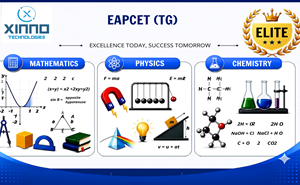
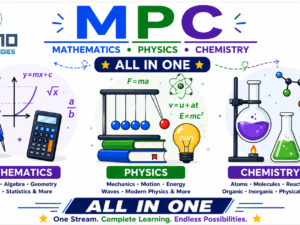
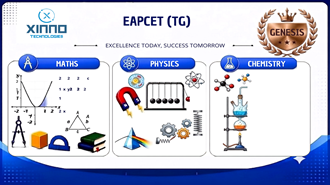
EAPCET stands for the Engineering, Agriculture, and Pharmacy Common Entrance Test.
It is a highly competitive, state-level computer-based entrance examination conducted in the Telugu states— Telangana (TG EAPCET) and Andhra Pradesh (AP EAPCET). It serves as the primary gateway for admission into various undergraduate professional programs in government and private colleges across these states.
Core Highlights of the Exam
|
Metric |
Details |
|
Exam Mode |
Online, Computer-Based Test (CBT) |
|
Duration |
3 Hours (180 minutes) |
|
Total Questions |
160 Multiple Choice Questions (MCQs) |
|
Marking Scheme |
+1 mark for each correct answer; no negative marking |
|
Medium |
Offered bilingual choices including English, Telugu, and Urdu |
|
Conducting Universities |
JNTU Kakinada (for AP) and JNTU Hyderabad (for Telangana) on behalf of their respective State Councils for Higher Education. |
Key Streams & Course Admissions
The exam is bifurcated into two primary entry streams depending on what a student took during their Intermediate (10+2) education:
1. Engineering Stream (MPC - Maths, Physics, Chemistry)
This stream caters to students looking to join technical and engineering programs, providing access to:
- B.Tech / B.E. across core branches (like Computer Science, ECE, Civil, Mechanical, etc.)
- Specialized engineering tracks like B.Tech in Dairy Technology, Agricultural Engineering, and Food Science & Technology.
2. Agriculture & Pharmacy Stream (BiPC - Biology, Physics, Chemistry)
This stream is designed for students focusing on life sciences and pharmaceutical tracks, granting access to:
- Agriculture & Veterinary: B.Sc. (Agriculture), B.Sc. (Horticulture), B.V.Sc. & A.H. (Veterinary Science), and B.F.Sc. (Fisheries).
- Pharmacy: B.Pharmacy and Pharm.D (Doctor of Pharmacy).
Basic Eligibility Criteria
- Educational Qualification: Candidates must have passed or be appearing for their final year of Intermediate (10+2) or equivalent with relevant vocational/core subject combinations.
- Minimum Marks: Generally, candidates require a minimum of 45% aggregate marks in their core subjects (40% for reserved categories).
- Qualifying Cutoff: To be considered for the ranking list, general candidates must secure a minimum of 25% of the maximum marks in the entrance test. There is no minimum qualifying cutoff mark prescribed for SC/ST candidates.
--------------------------------------------------------------------------
Genesis
FEATURES
📚 Class
- Live Interactive Classes by Expert Faculty
- Live Discussion of Practice Questions
- Live In-Class Doubt Solving
- Live Quizzes & Performance Leaderboard
- Classroom-Like Learning Experience
- Small Batch Size for Better Attention
After Class
- Assignments & Class Notes
- Weekly/Monthly Test Series
- Digital Study Material
- Post-Class Doubt Support
- Student Progress Reports
- Parent Portal Access
- Parent-Teacher Meetings
- Handwritten Faculty Notes
- Chapter-wise Tests
- Unlimited Practice Worksheets
- Mock Tests with Discussion
- Career Guidance Sessions
🌟 Value Adds
- Personalized Learning Experience
- Regular Performance Tracking
- Free Career Guidance