- Description
- Curriculum
- FAQ
- Reviews
 To book a demo class, Click Here
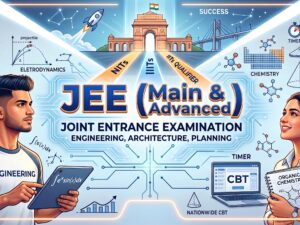
JEE (Main), or the Joint Entrance Examination (Main), is a premier national-level standardized test in India conducted by the National Testing Agency (NTA). Taken by over a million students annually after completing high school (Class 12), it serves two distinct purposes:
- Direct Admission: It is the sole gateway for admission to undergraduate engineering and architecture programs (B.E. / B.Tech, B.Arch, and B.Planning) across prestigious premier institutes like the National Institutes of Technology (NITs), Indian Institutes of Information Technology (IIITs), and other Centrally Funded Technical Institutes (CFTIs).
- Eligibility Screening: It acts as the screening prerequisite to qualify for JEE (Advanced)—the highly exclusive exam required to get into the Indian Institutes of Technology (IITs). Only the top ~250,000 score-holders from JEE (Main) are permitted to attempt JEE (Advanced).
Exam Structure & Mode
The entire examination is a Computer Based Test (CBT), where students sit at designated test centers and interact with an on-screen console.
The exam is split into three separate papers based on what course you intend to pursue:
- Paper 1: For B.E. / B.Tech courses (Most common path, testing Physics, Chemistry, and Mathematics).
- Paper 2A: For B.Arch (Architecture).
- Paper 2B: For B.Planning.
Paper 1 (B.Tech) Pattern & Marking Scheme
For core engineering aspirants, Paper 1 is structured out of 300 total marks and must be completed in exactly 3 hours.
Question Distribution per Subject
Each of the three sections (Physics, Chemistry, and Math) follows an identical distribution pattern:
- Section A (20 MCQs): Standard multiple-choice questions with 4 options and only 1 correct answer. All 20 are compulsory.
- Section B (10 Numerical Value Questions): Questions where the final answer is a specific numerical value you enter using an on-screen virtual keyboard. Candidates only need to attempt any 5 out of these 10.
The Marking Protocol
The NTA enforces a strict marking rule across both sections to discourage blind guessing:
- Correct Answer: +4 marks
- Incorrect Answer: -1 mark (Negative marking applies to both MCQs and Numerical questions)
- Unanswered/Marked for Review: 0 marks
Eligibility Criteria Basics
- Age Limit: There is no upper age limit specified by the NTA to take the test.
- Academic Window: Candidates can sit for the exam during the year they pass their Class 12 (or equivalent) exams, and in the immediate two consecutive years following it (a maximum window of 3 consecutive years).
- Admission Threshold: While anyone meeting the criteria can sit for the test, actual admission into an NIT, IIIT, or CFTI requires securing at least 75% marks in the Class 12 board examination (or being in the top 20 percentile of their respective board). For SC/ST candidates, this requirement is relaxed to 65%.
JEE (Advanced) is the second and final stage of the Joint Entrance Examination. It is widely considered one of the toughest undergraduate engineering admissions tests in the world.
While JEE Main opens doors to NITs and IIITs, JEE Advanced is the exclusive gateway for securing admission into the 23 premier Indian Institutes of Technology (IITs) and the Indian School of Mines (ISM), Dhanbad.
The Key Traits of JEE Advanced
Unlike JEE Main, which focuses heavily on speed, accuracy, and foundational syllabus tracking, JEE Advanced is built to test deep conceptual integration, abstract problem-solving, and intellectual endurance.
1. High-Stakes Eligibility
You cannot register for JEE Advanced directly. You must first qualify through JEE Main. Only the top 250,000 candidates (across all social and reservation categories) from the JEE Main rank list are invited to sit for this exam.
2. The Unpredictable Exam Pattern
JEE Advanced does not have a fixed total mark count or a rigid question template. The organizing IIT alters the test blueprint every year. Candidates must adapt on the fly to entirely new question mixes, which frequently include:
- One or More Than One Correct Option: Complex multiple-choice questions where picking partial correct answers gives fractional points, but picking any wrong option triggers negative marks.
- Numerical Value & Integer Types: Questions requiring a precise numerical calculation up to decimal places.
- Match the Matrix: Cross-referencing complex concepts from physics, chemistry, or math across columns.
- Paragraph/Comprehension Puzzles: Reading a technical or experimental premise and solving multiple dependent questions based on it.
3. Double-Paper Marathon
The entire exam is split into two mandatory tests conducted on the same day:
- Paper 1: 9:00 AM to 12:00 PM (3 Hours)
- Mandatory 2.5-hour break
- Paper 2: 2:30 PM to 5:30 PM (3 Hours)
Crucial Rule: Both Paper 1 and Paper 2 are completely compulsory. If a candidate skips or fails to complete either of the papers, they are disqualified from the ranking process entirely.
4. Strict Attempt Cap
While you can take JEE Main three times in three consecutive years, JEE Advanced allows a maximum of two attempts in two consecutive years, starting from the year you pass your Class 12 board examinations.
Academic Cutoffs for Ranking
To make it onto the final common merit list (CML), students must clear two distinct thresholds:
- Subject-wise Minimum Percentage: You must score a baseline minimum number of marks individually in Physics, Chemistry, and Mathematics.
- Aggregate Minimum Percentage: Your combined total score across all subjects must cross the general qualifying bar set for that year.
The Joint Entrance Examination (Advanced) has a significantly stricter and more narrow set of entry barriers than JEE Main. To be eligible to register for JEE Advanced and secure a seat at an IIT, a candidate must simultaneously fulfill five rigorous institutional and academic criteria.
The 5 Crucial Eligibility Gates
Criterion 1: Performance in JEE Main (The Merit Cutoff)
You cannot sit for JEE Advanced directly.
- The Baseline: You must be among the top 2,50,000 successful candidates who clear the B.E./B.Tech Paper 1 of JEE Main.
- Category Split: The total pool of qualified candidates is strictly divided by category quotas:
- OPEN (General): 40.5% (101,250 candidates)
- OBC-NCL: 27% (67,500 candidates)
- SC: 15% (37,500 candidates)
- GEN-EWS: 10% (25,000 candidates)
- ST: 7.5% (18,750 candidates)
- (A 5% horizontal reservation is applied within each block for PwD candidates).
Criterion 2: Strict Attempt Limitations
- The Cap: A candidate can attempt JEE Advanced a maximum of two times in two consecutive years.
- This is far more unforgiving than JEE Main, which permits three attempts across three consecutive years.
Criterion 3: Class 12 Appearance Window
Your high school passing timeline dictates your eligibility.
- The Window: You must have appeared for your Class 12 (or equivalent) examination for the first time in either the current calendar year or the immediate previous year.
- Students who took their first Class 12 boards even one year prior to that window are automatically disqualified, regardless of whether they dropped a year or updated their subjects.
Criterion 4: Absolute Age Limits
- General / OBC-NCL / EWS: Candidates must have been born on or after October 1, 2001.
- SC / ST / PwD: Given a 5-year relaxation window; candidates must have been born on or after October 1, 1996.
Criterion 5: Ban on Prior IIT Admissions
- If a candidate was previously allocated a seat at any IIT via JoSAA counseling and accepted it (by reporting online or at a center), or had their admission canceled after joining an IIT, they are permanently barred from writing JEE Advanced again.
Exception: Candidates who safely withdrew their allocated IIT seat before the absolute final round of counseling are permitted to re-attempt.
• Experienced IIT-JEE Faculty
• Live Interactive Classes
• Concept-Based Learning
• Daily Practice Problems (DPPs)
• Weekly & Grand Mock Tests
• Doubt Clearing Sessions
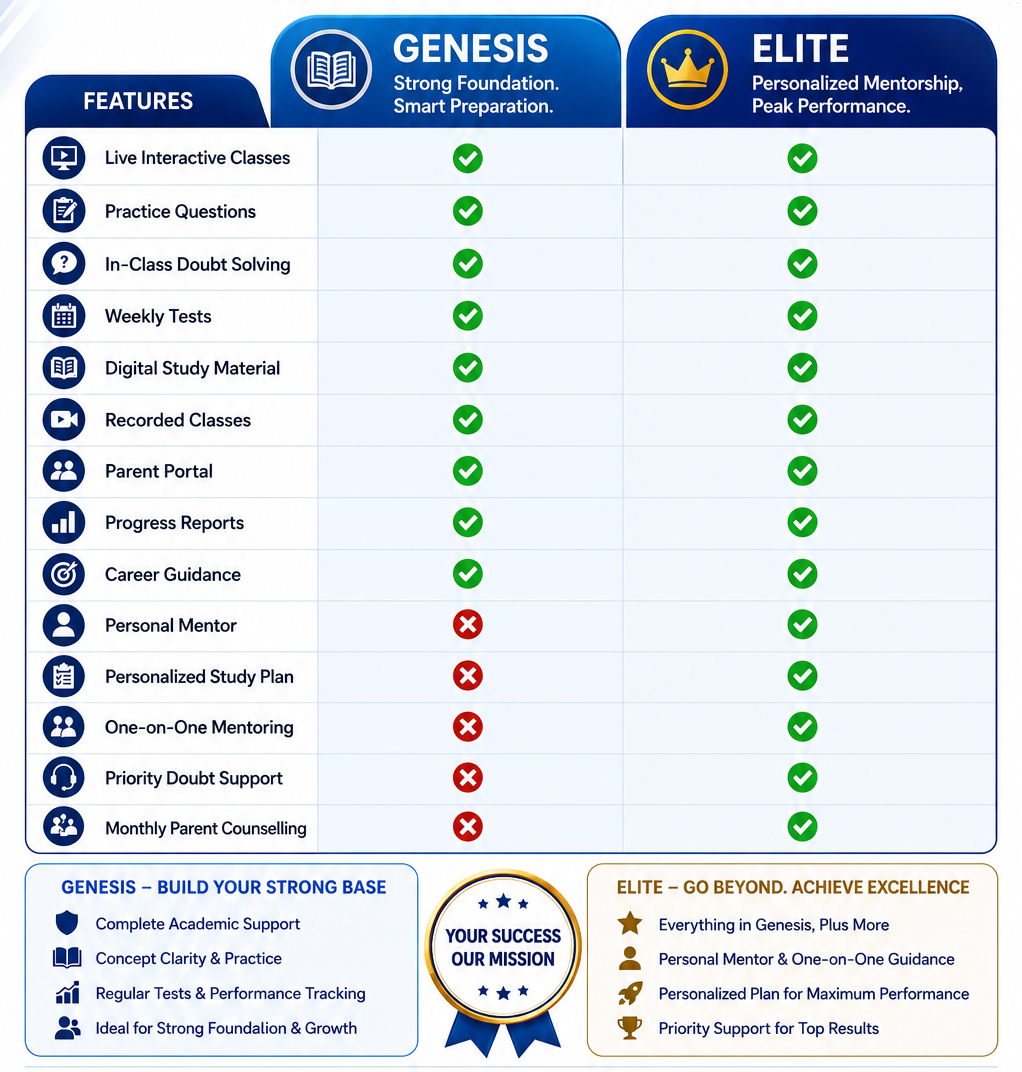
• Personalized Mentorship (Elite Plan)
• Performance Analytics & Parent Reports
Our structured approach helps students build strong fundamentals and improve exam performance.
• Qualify JEE Main and rank among the eligible candidates.
• Have passed or be appearing for Class 12 (or equivalent) with Physics, Chemistry, and Mathematics.
• Meet the age and attempt criteria prescribed by the authorities.
• Satisfy all eligibility conditions announced in the official information brochure.
Genesis
FEATURES
📚 Class
- Live Interactive Classes by Expert Faculty
- Live Discussion of Practice Questions
- Live In-Class Doubt Solving
- Live Quizzes & Performance Leaderboard
- Classroom-Like Learning Experience
- Small Batch Size for Better Attention
After Class
- Assignments & Class Notes
- Weekly/Monthly Test Series
- Digital Study Material
- Post-Class Doubt Support
- Student Progress Reports
- Parent Portal Access
- Parent-Teacher Meetings
- Handwritten Faculty Notes
- Chapter-wise Tests
- Unlimited Practice Worksheets
- Mock Tests with Discussion
- Career Guidance Sessions
🌟 Value Adds
- Personalized Learning Experience
- Regular Performance Tracking
- Free Career Guidance