Intermediate 1 st Year - Genesis

- Description
- Curriculum
- FAQ
- Reviews
 To book a demo class, Click Here
Subjects Covered: Mathematics, Physics and Chemistry
SYLLABUS
MATHEMATICS – IA
Unit 1: Functions
Types of Functions – Inverse Functions and Theorems – Domain and Range – Inverse of Real Valued Functions.
Unit 2: Mathematical Induction
Principle of Mathematical Induction – Applications of Mathematical Induction – Problems on Divisibility.
Unit 3: Matrices
Types of Matrices – Scalar Multiplication – Matrix Multiplication – Transpose of a Matrix – Determinants – Adjoint and Inverse of a Matrix – Rank of a Matrix – Consistency and Inconsistency of Equations – Solution of Simultaneous Linear Equations.
Unit 4: Addition of Vectors
Vectors as Ordered Triples – Classification of Vectors – Addition of Vectors – Scalar Multiplication – Angle Between Vectors – Linear Combination of Vectors – Components of a Vector in Three Dimensions – Vector Equations of Line and Plane.
Unit 5: Product of Vectors
Scalar Product – Geometrical Interpretation – Orthogonal Projections – Properties of Dot Product – Dot Product in i, j, k Form – Angle Between Vectors – Vector Product – Vector Areas – Scalar Triple Product – Vector Triple Product – Vector Equations of Planes.
Unit 6: Trigonometric Ratios up to Transformations
Graphs and Periodicity of Trigonometric Functions – Compound Angles – Multiple and Sub-Multiple Angles – Transformations – Sum and Product Formulae.
Unit 7: Trigonometric Equations
General Solutions of Trigonometric Equations – Simple Trigonometric Equations and Their Solutions.
Unit 8: Inverse Trigonometric Functions
Reduction of Trigonometric Functions into Bijections – Graphs of Inverse Trigonometric Functions – Properties of Inverse Trigonometric Functions.
Unit 9: Hyperbolic Functions
Definition and Graphs of Hyperbolic Functions – Inverse Hyperbolic Functions – Addition Formulae.
Unit 10: Properties of Triangles
Relation Between Sides and Angles – Sine Rule – Cosine Rule – Tangent Rule – Projection Rule – Half-Angle Formulae – Area of Triangle – In-circle and Ex-circle of a Triangle.
MATHEMATICS – IB
Unit 1: Locus
Definition of Locus – Equations of Locus – Applications and Problems on Locus.
Unit 2: Transformation
Transformation of Axes – Translation of Axes – Rotation of Axes – Derivations and Applications.
Unit 3: The Straight Line
Fundamental Results – Normal Form – Symmetric Form – Reduction into Various Forms – Intersection of Two Lines – Family of Straight Lines – Concurrent Lines – Conditions for Concurrency – Angle Between Lines – Length of Perpendicular – Distance Between Parallel Lines – Triangle Properties Based on Concurrent Lines.
Unit 4: Pair of Straight Lines
Equations of Pair of Lines Through Origin – Angle Between Pair of Lines – Conditions for Perpendicular and Coincident Lines – Bisectors of Angles – Pair of Lines from Second Degree Equations – Parallel Lines – Distance Between Parallel Lines – Point of Intersection – Homogenization of Equations.
Unit 5: Three Dimensional Coordinates
Coordinates in Space – Section Formula – Centroid of Triangle and Tetrahedron.
Unit 6: Direction Cosines and Direction Ratios
Direction Cosines – Direction Ratios – Relationship Between Direction Cosines and Direction Ratios.
Unit 7: Plane
Cartesian Equation of a Plane – Problems and Applications.
Unit 8: Limits and Continuity
Intervals and Neighbourhoods – Limits – Standard Limits – Continuity of Functions.
Unit 9: Differentiation
Derivative of a Function – Elementary Properties of Derivatives – Derivatives of Trigonometric, Inverse Trigonometric and Hyperbolic Functions – Methods of Differentiation – Second Order Derivatives.
Unit 10: Applications of Derivatives
Errors and Approximations – Tangents and Normals – Geometrical Interpretation of Derivatives – Lengths of Tangent and Normal – Angle Between Curves – Orthogonality of Curves – Derivative as Rate of Change – Rolle’s Theorem – Lagrange’s Mean Value Theorem – Increasing and Decreasing Functions – Maxima and Minima.
PHYSICS
Unit 1: Physical World
What is Physics – Scope and Excitement of Physics – Physics, Technology and Society – Fundamental Forces in Nature – Nature of Physical Laws.
Unit 2: Units and Measurements
SI System of Units – Measurement of Length, Mass and Time – Accuracy and Precision – Errors in Measurement – Significant Figures – Dimensions and Dimensional Analysis.
Unit 3: Motion in a Straight Line
Position, Path Length and Displacement – Average and Instantaneous Velocity – Acceleration – Equations of Motion – Relative Velocity.
Unit 4: Motion in a Plane
Scalars and Vectors – Vector Addition and Subtraction – Resolution of Vectors – Motion in a Plane – Projectile Motion – Uniform Circular Motion – Relative Velocity in Two Dimensions.
Unit 5: Laws of Motion
Aristotle’s Fallacy – Law of Inertia – Newton’s Laws of Motion – Conservation of Momentum – Equilibrium of a Particle – Friction – Circular Motion – Applications of Mechanics.
Unit 6: Work, Energy and Power
Work-Energy Theorem – Work Done by Variable Force – Kinetic and Potential Energy – Conservation of Mechanical Energy – Energy Conservation – Power – Collisions.
Unit 7: System of Particles and Rotational Motion
Centre of Mass – Motion of Centre of Mass – Linear Momentum – Angular Velocity – Torque – Angular Momentum – Equilibrium of Rigid Bodies – Moment of Inertia – Rolling Motion.
Unit 8: Oscillations
Periodic Motion – Simple Harmonic Motion – SHM and Circular Motion – Velocity and Acceleration in SHM – Energy in SHM – Damped Oscillations – Forced Oscillations and Resonance.
Unit 9: Gravitation
Kepler’s Laws – Universal Law of Gravitation – Gravitational Constant – Acceleration Due to Gravity – Escape Velocity – Satellites – Weightlessness.
Unit 10: Mechanical Properties of Solids
Elastic Behaviour – Stress and Strain – Hooke’s Law – Stress-Strain Curve – Elastic Moduli – Applications of Elasticity.
Unit 11: Mechanical Properties of Fluids
Pressure – Streamline Flow – Bernoulli’s Principle – Viscosity – Reynolds Number – Surface Tension.
Unit 12: Thermal Properties of Matter
Temperature and Heat – Measurement of Temperature – Ideal Gas Equation – Thermal Expansion – Specific Heat Capacity – Calorimetry – Change of State – Heat Transfer – Newton’s Law of Cooling.
Unit 13: Thermodynamics
Thermal Equilibrium – Zeroth Law – First Law of Thermodynamics – Thermodynamic Processes – Heat Engines – Refrigerators and Heat Pumps – Second Law of Thermodynamics – Carnot Engine and Carnot Theorem.
Unit 14: Kinetic Theory
Molecular Nature of Matter – Behaviour of Gases – Kinetic Theory of Ideal Gases – Law of Equipartition of Energy – Specific Heat Capacity – Mean Free Path.
CHEMISTRY
Unit 1: Atomic Structure
Sub-atomic particles – Rutherford’s Nuclear Model of Atom – Developments to Bohr’s Model – Bohr’s Model for Hydrogen Atom – Quantum Mechanical Model of Atom – Orbitals and Quantum Numbers – Shapes and Energies of Atomic Orbitals – Aufbau Principle – Pauli’s Exclusion Principle – Hund’s Rule of Maximum Multiplicity – Electronic Configuration of Atoms – Stability of Half-filled and Completely Filled Orbitals.
Unit 2: Classification of Elements and Periodicity in Properties
Need for Classification of Elements – Genesis of Periodic Classification – Modern Periodic Law and Periodic Table – Nomenclature of Elements with Atomic Number Greater than 100 – Electronic Configuration and Periodic Table – Types of Elements (s, p, d, f Block Elements) – Periodic Trends in Physical and Chemical Properties – Chemical Reactivity.
Unit 3: Chemical Bonding and Molecular Structure
Kossel-Lewis Approach to Chemical Bonding – Ionic (Electrovalent) Bond – Bond Parameters – VSEPR Theory – Valence Bond Theory – Hybridization – Coordinate Bond – Molecular Orbital Theory – Bonding in Homonuclear Diatomic Molecules – Hydrogen Bonding.
Unit 4: States of Matter: Gases and Liquids
Intermolecular Forces – Thermal Energy – Gaseous State – Gas Laws – Ideal Gas Equation – Graham’s Law of Diffusion – Dalton’s Law of Partial Pressures – Kinetic Molecular Theory of Gases – Kinetic Gas Equation – Distribution of Molecular Speeds – Real Gases and Deviation from Ideal Behaviour – Compressibility Factor – Liquefaction of Gases – Liquid State – Vapour Pressure – Viscosity – Surface Tension.
Unit 5: Stoichiometry
Basic Concepts – Laws of Chemical Combination – Gay Lussac’s Law – Dalton’s Atomic Theory – Avogadro’s Law – Atomic and Molecular Masses – Mole Concept – Molar Mass – Equivalent Weight – Percentage Composition – Empirical and Molecular Formulae – Stoichiometric Calculations – Concentration Terms – Redox Reactions – Oxidation Number – Types of Redox Reactions – Balancing Redox Equations – Redox Reactions in Titrimetry.
Unit 6: Thermodynamics
Thermodynamic Terms – Work, Heat and Internal Energy – Enthalpy – Extensive and Intensive Properties – Heat Capacity – Calorimetry – Enthalpy Changes of Reactions – Different Types of Enthalpies – Spontaneity – Gibbs Energy and Equilibrium – Entropy – Third Law of Thermodynamics.
Unit 7: Chemical Equilibrium and Acids-Bases
Physical and Chemical Equilibrium – Dynamic Equilibrium – Law of Mass Action – Equilibrium Constant – Homogeneous and Heterogeneous Equilibria – Relationship between Kp and Kc – Applications of Equilibrium Constant – Reaction Quotient and Gibbs Energy – Le Chatelier’s Principle – Ionic Equilibrium – Arrhenius, Bronsted-Lowry and Lewis Concepts of Acids and Bases – Ionization of Acids and Bases – Buffer Solutions – Solubility Product and Common Ion Effect.
Unit 8: Hydrogen and its Compounds
Position of Hydrogen in the Periodic Table – Occurrence and Isotopes of Hydrogen – Preparation and Properties of Dihydrogen – Hydrides – Water and its Properties – Hard and Soft Water – Hydrogen Peroxide – Heavy Water – Hydrogen as a Fuel.
Unit 9: s-Block Elements (Alkali and Alkaline Earth Metals)
Alkali Metals – Electronic Configuration – Physical and Chemical Properties – Compounds of Alkali Metals – Anomalous Properties of Lithium – Important Compounds of Sodium – Biological Importance of Sodium and Potassium – Alkaline Earth Metals – Physical and Chemical Properties – Compounds of Alkaline Earth Metals – Anomalous Behaviour of Beryllium – Diagonal Relationship with Aluminium – Important Compounds of Calcium – Biological Importance of Calcium and Magnesium.
Unit 10: p-Block Elements – Group 13 (Boron Family)
Electronic Configuration – Atomic Radii – Ionization Enthalpy – Electronegativity – Physical and Chemical Properties – Anomalous Properties of Boron – Borax – Orthoboric Acid – Diborane – Uses of Boron, Aluminium and their Compounds.
Unit 11: p-Block Elements – Group 14 (Carbon Family)
Electronic Configuration – Physical and Chemical Properties – Anomalous Properties of Carbon – Allotropes of Carbon – Uses of Carbon – Carbon Monoxide – Carbon Dioxide – Silica – Silicones – Silicates – Zeolites.
Unit 12: Environmental Chemistry
Air, Water and Soil Pollution – Environmental Pollution – Atmospheric Pollution – Acid Rain – Particulate Pollutants – Stratospheric Pollution – Water Pollution – Soil Pollution – Pesticides and Industrial Wastes – Control of Environmental Pollution – Green Chemistry.
Unit 13: Organic Chemistry – Some Basic Principles and Techniques & Hydrocarbons
General Introduction – Tetravalency of Carbon – Shapes and Structural Representation of Organic Compounds – Classification and Nomenclature of Organic Compounds – Isomerism – Organic Reaction Mechanisms – Purification and Analysis of Organic Compounds – Classification of Hydrocarbons – Alkanes, Alkenes and Alkynes (Preparation, Properties and Isomerism) – Aromatic Hydrocarbons – Benzene Structure, Resonance and Aromaticity – Directive Influence of Functional Groups – Carcinogenicity and Toxicity.
• Understanding concepts thoroughly instead of memorizing formulas.
• Practicing numerical problems, worksheets, and assignments regularly.
• Solving previous year question papers and mock tests.
• Developing logical thinking and analytical problem-solving skills.
• Relating theoretical concepts to practical and real-world applications.
• Revising important topics consistently.
• Maintaining a positive attitude and disciplined study routine.
• Building confidence through personalized guidance.
• Encouraging curiosity and critical thinking.
• Focusing on conceptual understanding rather than rote learning.
• Conducting interactive classroom sessions.
• Providing regular assignments and practice exercises.
• Conducting weekly tests and performance evaluations.
• Offering timely doubt-clearing support.
• Helping students develop strong analytical and problem-solving abilities.
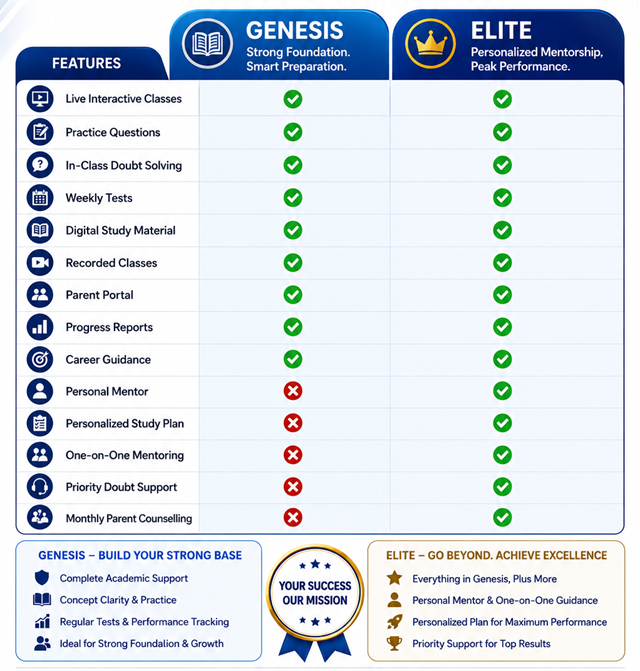
Genesis
FEATURES
📚 Class
- Live Interactive Classes by Expert Faculty
- Live Discussion of Practice Questions
- Live In-Class Doubt Solving
- Live Quizzes & Performance Leaderboard
- Classroom-Like Learning Experience
- Small Batch Size for Better Attention
After Class
- Assignments & Class Notes
- Weekly/Monthly Test Series
- Digital Study Material
- Post-Class Doubt Support
- Student Progress Reports
- Parent Portal Access
- Parent-Teacher Meetings
- Handwritten Faculty Notes
- Chapter-wise Tests
- Unlimited Practice Worksheets
- Mock Tests with Discussion
- Career Guidance Sessions
🌟 Value Adds
- Personalized Learning Experience
- Regular Performance Tracking
- Free Career Guidance