- Description
- Curriculum
- FAQ
- Reviews
 To book a demo class, Click Here
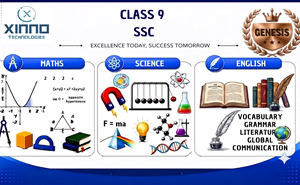
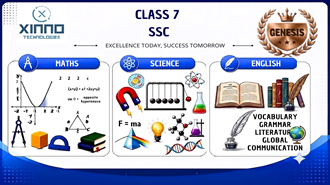
Subjects Covered: Mathematics, Science and English
SYLLABUS
MATHEMATICS
1. INTEGERS
Addition, subtraction, multiplication and division of integers – Properties of integers including closure, commutative, associative and distributive properties – Identity and inverse properties – Multiplication and division by zero – Word problems involving integers.
2. FRACTIONS, DECIMALS AND RATIONAL NUMBERS
Multiplication and division of fractions – Fraction as an operator – Reciprocal of fractions – Rational numbers and their properties – Decimal operations – Conversion of units – Applications through daily-life problems.
3. EXPONENTS AND POWERS
Exponential notation – Prime factorization using exponents – Laws of exponents – Numbers with zero exponent – Scientific notation and large numbers.
4. ALGEBRAIC EXPRESSIONS
Generation of algebraic expressions – Constants, variables and coefficients – Like and unlike terms – Degree of expressions – Addition and subtraction of algebraic expressions – Evaluation of expressions.
5. SIMPLE EQUATIONS
Linear equations in one variable – Equations arising from contextual situations – Solving equations using arithmetic operations – Word problems.
6. RATIO AND APPLICATIONS
Ratio and proportion – Unitary method – Direct proportion – Percentage – Profit and loss – Discount – Simple interest – Applications in business and daily life.
7. GEOMETRY
Lines and angles – Complementary, supplementary, adjacent and vertically opposite angles – Transversals and parallel lines – Triangles and their properties – Congruence of triangles – Construction of triangles – Quadrilaterals and their properties – Reflection and rotational symmetry.
8. MENSURATION
Area and perimeter of rectangles and squares – Area of parallelograms, triangles and rhombuses – Circumference of circles – Rectangular paths and practical applications.
9. DATA HANDLING
Collection and organization of data – Mean, median and mode of ungrouped data – Reading bar graphs – Double bar graphs – Simple pie charts and interpretation of data.
SCIENCE
1. FOOD COMPONENTS: Listing food components – Essential food components – Tests for carbohydrates, fats and proteins – Roughages and dietary fibres – Sources of fibres – Water – Balanced diet – Avoiding junk food – History of food and nutrition.
2. ACIDS AND BASES: Food items based on taste – Turmeric paper indicator – Natural indicators – Litmus tests – Acidic substances – Basic substances – Chemical indicators (Phenolphthalein, Methyl Orange) – Acid rain – Neutralization – Organic manures – Salts – Uses of acids, bases and salts.
3. ANIMAL FIBRE: Story of silk – Moth to egg – Cocoon to fibre – Reeling – Weaving – Story of wool – Shearing – Scouring – Sorting – Dyeing – Carding – Spinning – Rolling and twisting – Knitting – Differences between silk and cotton.
4. MOTION AND TIME: Motion around us – Motion and rest – Relative motion – Uniform motion – non-uniform motion – Translatory motion – Rotary motion – Oscillatory motion – Slow and fast motions – Estimating time – Units of time – Stop clock – Speed – Units of speed – Calculations.
5. HEAT – MEASUREMENTS: Seasons and temperature – Temperature – Heat as a form of energy – Conversion of energy – Heat and temperature – Measuring temperature – Clinical thermometer – MMT – Digital thermometer – Laboratory thermometer – Use of thermometers – Expansion of liquids.
6. WEATHER AND CLIMATE: Weather prediction – Weather reports – Components of weather – Measuring temperature – Rain gauge – Wind direction – Humidity – Cyclic weather conditions – Climate – Climate and lifestyle.
7. ELECTRICITY – CURRENT AND ITS EFFECT: Make your own cell – Dry cell – Symbols of electrical components – Circuit diagrams – Series circuits – Parallel circuits – Heating effect of current – Tube light – Compact fluorescent lamp – Electric fuse – Miniature Circuit Breaker (MCB) – Electricity billing.
8. AIR, WINDS AND CYCLONES: Air and daily life – Air around us – Air pressure – Expansion of air on heating – Hot air and cold air – Warm air rises – Moving air – Wind formation – Cyclone formation – Factors contributing to cyclones – Safety during cyclones.
9. REFLECTION OF LIGHT: Reflection of light – Observation of reflection – Laws of reflection – Regular reflection – Irregular reflection – Angle of incidence – Angle of reflection – Periscope – Mirror images – Virtual images – Real images – Kaleidoscope – Convex mirrors – Concave mirrors – Images formed by spherical mirrors.
10. NUTRITION IN PLANTS: Von Helmont experiment – Photosynthesis – Exchange of air through stomata – Autotrophic nutrition – Heterotrophic nutrition – Parasitic plants – Haustoria – Insectivorous plants – Saprophytes – Symbiosis.
11. RESPIRATION IN ORGANISMS: Human respiration – Pulse counting – Chest expansion – Measuring air in each breath – Inhaled and exhaled air – Discovery of oxygen and carbon dioxide – Gases in breath – Breathing in fish, frog, cockroach and earthworm – Respiration in plants and sprouted seeds.
12. REPRODUCTION IN PLANTS: Flower structure – Thalamus – Calyx – Corolla – Androecium – Gynoecium – Complete flowers – Incomplete flowers – Unisexual flowers – Bisexual flowers – Pollen grains – Ovary – Self-pollination – Cross-pollination – Agents of pollination – Fertilization – Fruit formation – Seed formation – Budding – Spores – Vegetative reproduction.
13. SEED DISPERSAL: Need for seed dispersal – Different kinds of seeds – Seed dispersal by wind – Water – Birds – Animals – Bursting fruits – Human beings – Seeds in fruits.
14. WATER – TOO LITTLE TO WASTE: Sources of water – Water as a precious resource – Impurities in sewage – Wastewater treatment – Diseases caused by untreated water – Sewage disposal methods – Drainage systems – Water conservation.
15. SOIL – OUR LIFE: Usefulness of soil – Soil and life – Soil life chart – Soil as habitat – Soil properties – Types of soil – Soil moisture – Percolation rate – Substances present in soil – Soil horizons – Soil in our village – Soil and crops – Soil conservation.
16. FOREST – OUR LIFE: Orchard – Forest – Diversity in forests – Types of forests in the state – People living in forests – Destruction of forests – Conservation of forests.
17. CHANGES AROUND US: Periodic changes – Physical changes – Chemical changes – Changes in ice on heating – Changes caused by burning – Rusting of iron – Galvanization – Browning of cut vegetables and prevention – Changes in magnesium ribbon – Chemical reactions involving copper sulphate and iron – Vinegar and baking soda reaction – Burning of camphor – Crystallization of urea – Crystallization of copper sulphate.
ENGLISH
Unit 1. Neighborhood: A Reading: The Town Mouse and the Country Mouse (Story) – B Reading: The Town Child and The Country Child (Poem) by Irene Thompson – C Reading: The New Blue Dress (Story) – Vocabulary: Phrases, Compound Nouns – Grammar: Degrees of Comparison, Use of May, Expressing Unreal Past Using Wish – Written Discourses: Description, Personal Letter, Play Script – Oral Discourses: Short Speech, Conversation, Play.
Unit 2. Science and Technology: A Reading: C.V. Raman, the Pride of India (Biography) – B Reading: It’s Change (Poem) by Emma Gorrie – C Reading: Susruta, an Ancient Plastic Surgeon (Biography) – Vocabulary: Verb to Noun Forms, Abbreviations, Rhyming Words – Grammar: Prepositions of Time and Place, Articles – Written Discourses: Biographical Sketch – Oral Discourses: Short Talk, Debate.
Unit 3. Nation and Diversity: A Reading: Puru, the Brave (Play) – B Reading: Home They Brought Her Warrior Dead (Poem) by Alfred Lord Tennyson – C Reading: The Magic of Silk (Story) – Vocabulary: Antonyms – Grammar: Should and Must, Degrees of Comparison – Written Discourses: Conversion of Play into Short Story – Oral Discourses: Narrative.
Unit 4. Wit and Humor: A Reading: Tenali Paints a Horse (Play) – B Reading: Dear Mum (Poem) by Brian Patten – C Reading: The Emperor’s New Clothes (Folk Tale) – Vocabulary: Phrasal Verbs, Idioms – Grammar: Contracted Forms, Adverbs of Manner – Written Discourses: Narrative – Oral Discourses: Enacting a Play.
Unit 5. Travel and Tourism: A Reading: A Trip to Andaman (Narrative) – B Reading: My Trip to the Moon (Poem) – C Reading: Sindbad the Sailor (Narrative) – Vocabulary: Antonyms, Phrasal Verbs – Grammar: Simple Past and Past Continuous – Written Discourses: Description, Letter – Oral Discourses: Description.
Unit 6. Adventure: A Reading: A Hero (Story) – B Reading: My Nasty Adventure (Poem) by Jim Corbett – C Reading: Learn How to Climb Trees (Narrative) – Vocabulary: Synonyms, Proverbs – Grammar: Simple Past, Past Continuous – Written Discourses: Diary Entry, Description, Play Script – Oral Discourses: Story Telling.
Unit 7. Games and Sports: A Reading: The Wonderful World of Chess (Essay) – B Reading: Chess (Poem) – C Reading: Koneru Humpy (Biography) – Vocabulary: Synonyms, Hypernyms, Hyponyms – Grammar: If Clauses – Written Discourses: Essay – Oral Discourses: Conversation.
Unit 8. Environment: A Reading: Snakes in India (Essay) – B Reading: Trees (Poem) – C Reading: A Letter from Mother Earth (Letter) – Vocabulary: Prefixes and Suffixes – Grammar: Conjunctions Until, As Long As, Subject and Predicate – Written Discourses: Poster, Poem – Oral Discourses: Reporting an Event.
Reading and revising lessons regularly.
Understanding concepts instead of memorizing.
Practicing worksheets, assignments, and sample papers.
Strengthening grammar, vocabulary, formulas, and scientific concepts.
Solving additional practice questions.
Asking doubts whenever needed.
Maintaining consistency and a positive attitude toward learning.
Building confidence and motivation.
Encouraging questions and curiosity.
Focusing on conceptual understanding rather than rote learning.
Providing interactive classroom sessions.
Giving regular assignments and practice exercises.
Conducting tests and performance evaluations.
Offering timely doubt-clearing support.
Helping students develop analytical and problem-solving skills.
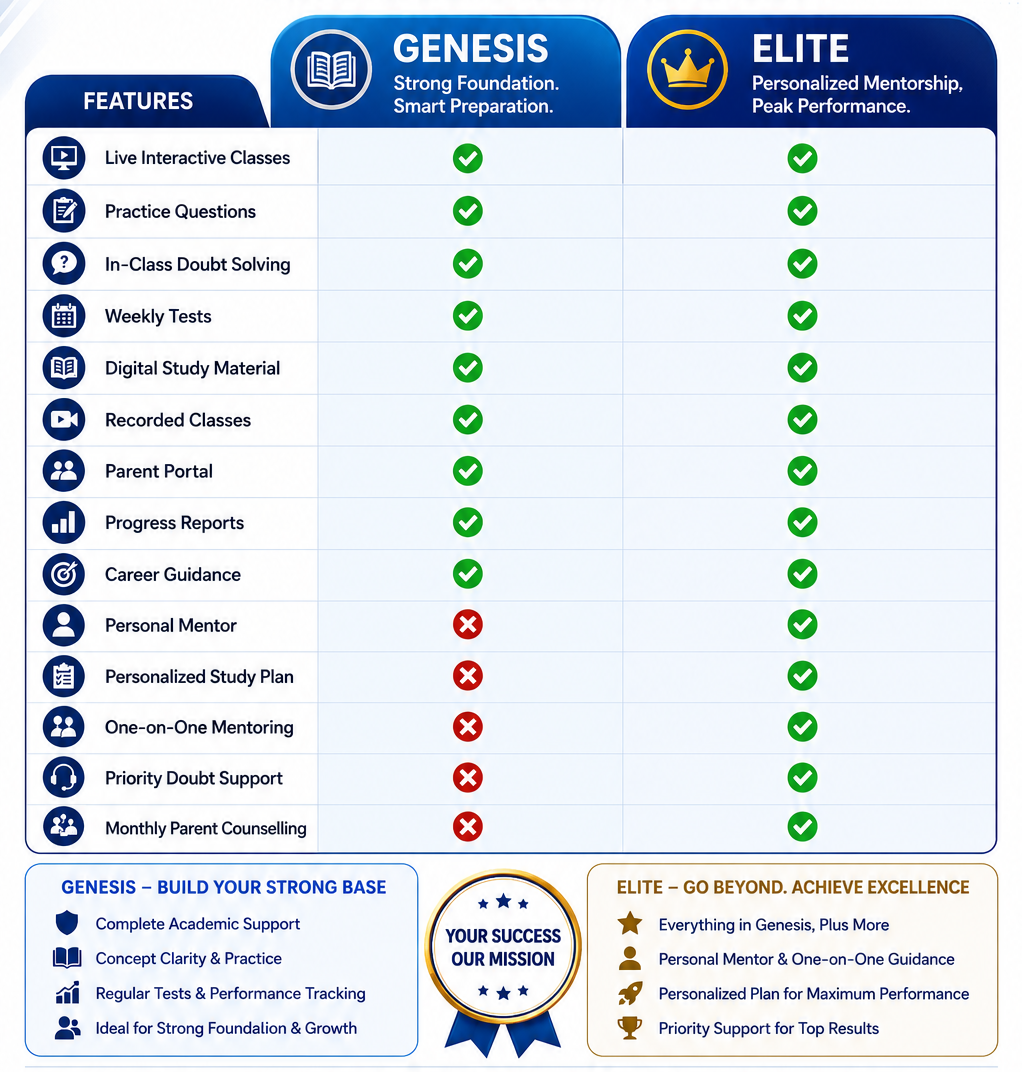
Genesis
FEATURES
📚 Class
- Live Interactive Classes by Expert Faculty
- Live Discussion of Practice Questions
- Live In-Class Doubt Solving
- Live Quizzes & Performance Leaderboard
- Classroom-Like Learning Experience
- Small Batch Size for Better Attention
After Class
- Assignments & Class Notes
- Weekly/Monthly Test Series
- Digital Study Material
- Post-Class Doubt Support
- Student Progress Reports
- Parent Portal Access
- Parent-Teacher Meetings
- Handwritten Faculty Notes
- Chapter-wise Tests
- Unlimited Practice Worksheets
- Mock Tests with Discussion
- Career Guidance Sessions
🌟 Value Adds
- Personalized Learning Experience
- Regular Performance Tracking
- Free Career Guidance