- Description
- Curriculum
- FAQ
- Reviews
 To book a demo class, Click Here
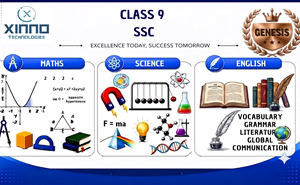
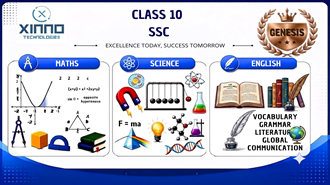
Subjects Covered: Mathematics, Science and English
SYLLABUS
MATHEMATICS
1. REAL NUMBERS
Euclid’s Division Lemma – HCF and LCM – Fundamental Theorem of Arithmetic – Rational and irrational numbers – Proofs of irrationality – Decimal expansion of rational numbers – Introduction to logarithms – Conversion between exponential and logarithmic forms – Laws and properties of logarithms.
2. POLYNOMIALS
Zeroes of linear, quadratic and cubic polynomials – Relationship between zeroes and coefficients – Division algorithm for polynomials – Biquadratic polynomials – Applications of polynomial equations.
3. PAIR OF LINEAR EQUATIONS IN TWO VARIABLES
Graphical representation of solutions – Consistent and inconsistent systems – Algebraic methods including substitution and elimination – Situational and word problems – Equations reducible to linear equations in two variables.
4. QUADRATIC EQUATIONS
Standard form of quadratic equations – Solutions by factorization – Completing the square – Quadratic formula – Discriminant and nature of roots – Real-life applications and word problems.
5. PROGRESSIONS
Sequences and series – Arithmetic Progressions (AP) – Finding the nth term – Sum of n terms – Geometric Progressions (GP) – Finding the nth term of a GP – Applications of progressions.
6. TRIGONOMETRY
Trigonometric ratios of acute angles – Sine, cosine, tangent, cosecant, secant and cotangent – Values of trigonometric ratios for 30°, 45° and 60° – Trigonometric identities – Complementary angles – Angle of elevation and depression – Heights and distances – Applications in surveying and real-life situations.
7. COORDINATE GEOMETRY
Distance formula – Section formula – Area of a triangle using coordinates – Slope of a line – Applications in geometry and graphing.
8. SIMILAR TRIANGLES AND CIRCLES
Similarity criteria (AAA, SSS, SAS) – Basic proportionality theorem – Areas of similar triangles – Pythagoras theorem and converse – Tangents to circles – Properties of tangents – Segments of circles – Construction of tangents from external points.
9. SURFACE AREAS AND VOLUMES
Surface areas and volumes of combinations of cubes, cuboids, cylinders, cones, spheres and hemispheres – Conversion of one solid into another – Practical problems involving volume and capacity.
10. STATISTICS AND PROBABILITY
Mean, median and mode for grouped and ungrouped data – Frequency distributions – Ogives and cumulative frequency curves – Probability of simple events – Complementary events – Applications of probability in everyday situations.
SCIENCE
1. Nutrition: Life Processes – Autotrophic and Heterotrophic Nutrition – Photosynthesis – Raw Materials for Photosynthesis – Oxygen Release – Light Requirement – Chlorophyll – Site of Photosynthesis – Light Reaction – Dark Reaction – Nutrition in Organisms – Cuscuta – Digestion in Human Beings – Alimentary Canal – Enzymes – Human Digestive System – Oesophagus – Malnutrition – Kwashiorkor – Marasmus – Obesity – Vitamin Deficiency Diseases.
2. Respiration: Discovery of Gases – Stages of Respiration – Inspiration and Expiration – Air Pathway – Epiglottis – Human Respiratory System – Exchange of Gases – Transport of Gases – Cellular Respiration – Aerobic Respiration – Anaerobic Respiration – Fermentation – Respiration and Combustion – Evolution of Gaseous Exchange – Plant Respiration – Gas Transport in Plants – Root Respiration – Photosynthesis and Respiration.
3. Transportation: Structure of Heart – Blood Vessels – Capillaries – Arteries – Veins – Cardiac Cycle – Single and Double Circulation – Lymphatic System – Evolution of Transport System – Blood Pressure – Blood Clotting – Water Absorption – Root Hair Absorption – Root Pressure – Ascent of Sap – Cohesive and Adhesive Forces – Mineral Transport – Food Transport.
4. Excretion: Human Excretion – Excretory System – Kidney – Internal Structure of Kidney – Nephron – Formation of Urine – Glomerular Filtration – Tubular Reabsorption – Tubular Secretion – Hypertonic Urine – Ureter – Urinary Bladder – Urethra – Dialysis – Artificial Kidney – Kidney Transplantation – Accessory Excretory Organs – Excretion in Other Organisms – Excretion in Plants – Alkaloids – Tannins – Resins – Gums – Latex – Excretion and Secretion.
5. Control and Coordination: Stimulus and Response – Nervous Coordination – Nerve Cell Structure – Afferent Nerves – Efferent Nerves – Reflex Arc – Central Nervous System – Brain – Spinal Cord – Peripheral Nervous System – Coordination Without Nerves – Insulin – Endocrine Glands – Feedback Mechanism – Autonomic Nervous System – Phytohormones – Plant Responses – Tropic Movements.
6. Reproduction: Growth of Bacteria in Milk – Asexual Reproduction – Fission – Budding – Fragmentation – Parthenocarpy – Parthenogenesis – Regeneration – Vegetative Propagation – Natural and Artificial Methods – Cuttings – Layering – Grafting – Spores – Sexual Reproduction – Human Reproductive System – Child Birth – Reproduction in Plants – Flower Structure – Pollination – Pollen Grain – Ovule – Ovary – Double Fertilization – Seed Germination – Cell Cycle – G1 – S – G2 – M Phase – Mitosis – Meiosis – Reproductive Health – HIV/AIDS – Birth Control – Female Foeticide.
7. Coordination in Life Processes: Hunger – Hunger Stimulus – Taste and Smell – Tongue and Palate – Mastication – Saliva Action – pH of Mouth – Peristalsis – Stomach Function – Movement of Food – Waste Elimination.
8. Heredity: Variations – Mendel’s Experiments – F1 and F2 Generations – Mendel’s Laws – Phenotype – Genotype – Inheritance – Sex Determination – Evolution – Genetic Drift – Lamarckism – Darwinism – Origin of Species – Homologous Organs – Analogous Organs – Embryological Evidence – Fossil Evidence – Human Evolution – Vestigial Organs.
9. Our Environment: Ecosystem – Food Chain – Number Pyramid – Biomass Pyramid – Energy Pyramid – Human Impact on Ecosystems – Kolleru Lake – Edulabad Reservoir – Heavy Metals – Sparrow Campaign – Biological Pest Control – Crop Rotation – Gene Mutation – Environmental Concern.
10. Natural Resources: Agricultural Land Case Study – Water Management – Community Participation – Farmer Interventions – Wasteland Cultivation – Water Resources in Telugu States – Natural Resources – Forest Resources – Soil – Biodiversity – Fossil Fuels – Minerals – Conservation – Reduce – Reuse – Recycle – Recover – Conservation Groups.
ENGLISH
Unit 1. Personality Development: A Reading: Attitude is Altitude (Biography) from Daily Mail – B Reading: Every Success Story Is Also a Story of Great Failures (Essay) by Sudha Murthy – C Reading: I Will Do It (Biography) – Vocabulary: Adjectives, Synonyms, One-Word Substitutes – Grammar: Defining and Non-Defining Relative Clauses – Written Discourses: Biographical Sketch, Story – Oral Discourses: Debate.
Unit 2. Wit and Humor: A Reading: The Dear Departed Part I (Play) by W.S. Houghton – B Reading: The Dear Departed Part II (Play) by W.S. Houghton – C Reading: The Brave Potter (Folk Tale) by Marguerite Siek – Vocabulary: Compound Adjectives, Commonly Confused Words, Idiomatic Expressions – Grammar: Articles, Compound Prepositional Phrases, Simple Past and Present Perfect – Written Discourses: Letter, Conversion of Play into Story – Oral Discourses: Role Play.
Unit 3. Human Relations: A Reading: The Journey (Narrative) by Y.D. Thongchi – B Reading: Another Woman (Poem) by Imtiaz Dharker – C Reading: The Never-Never Nest (Play) by Cedric Mount – Vocabulary: Compound Words (Hyphenated, Open and Closed) – Grammar: Simple Past and Past Perfect Tense – Written Discourses: Essay – Oral Discourses: Description, Short Talk.
Unit 4. Films and Theatre: A Reading: Rendezvous with Ray (Essay) from Frontline – B Reading: Maya Bazaar (Review) from The Hindu – C Reading: A Tribute (Essay) – Vocabulary: Collocations, One-Word Substitutions, Binomials – Grammar: Linkers, Adjectives, Prepositions, Verb Forms (Past Perfect, Simple Past), Modals – Written Discourses: Film/TV Review, Reply Letter, Skit, Report – Oral Discourses: Short Talk.
Unit 5. Social Issues / Agrarian Issues: A Reading: The Storeyed House Part I (Story) by Waman G. Hoval – B Reading: The Storeyed House Part II (Story) by Waman G. Hoval – C Reading: Abandoned (Poem) by Suraya Nasim – Vocabulary: Compound Adjectives, Phrasal Verbs, Idioms – Grammar: Adverbial Clauses – Written Discourses: Invitation, News Report, Essay – Oral Discourses: Speech.
Unit 6. Biodiversity: A Reading: Environment (Interview) from GBMNA – B Reading: Or Will the Dreamer Wake? (Poem) by M. Chevalier – C Reading: A Tale of Three Villages (Essay) – Vocabulary: Synonyms, Appropriate Forms of Words – Grammar: Non-Finite Clauses, Reported Speech, Adjectives, Quantifiers (No, Any, All, Some, Each, Several, Every) – Written Discourses: Interview, Description (Write-up) – Oral Discourses: Debate.
Unit 7. Nation and Diversity: A Reading: My Childhood (Autobiography) by A.P.J. Abdul Kalam – B Reading: A Plea for India (Poem) – C Reading: Unity in Diversity in India (Essay) – Vocabulary: Synonyms – Grammar: Linkers, Passive Voice Without Agent – Written Discourses: Diary Entry, Reply Letter – Oral Discourses: Short Talk, Role Play, Group Discussion.
Unit 8. Human Rights: A Reading: Jamaican Fragment (Narrative) by A.L. Hendricks – B Reading: Once Upon a Time (Poem) by Gabriel Okara – C Reading: What Is My Name? (Story) by P. Satyavathi – Vocabulary: Synonyms, Similes, Metaphors – Written Discourses: Essay, Speech – Oral Discourses: Debate, Speech.
Reading and revising lessons regularly.
Understanding concepts instead of memorizing.
Practicing worksheets, assignments, and sample papers.
Strengthening grammar, vocabulary, formulas, and scientific concepts.
Solving additional practice questions.
Asking doubts whenever needed.
Maintaining consistency and a positive attitude toward learning.
Building confidence and motivation.
Encouraging questions and curiosity.
Focusing on conceptual understanding rather than rote learning.
Providing interactive classroom sessions.
Giving regular assignments and practice exercises.
Conducting tests and performance evaluations.
Offering timely doubt-clearing support.
Helping students develop analytical and problem-solving skills.

Genesis
FEATURES
📚 Class
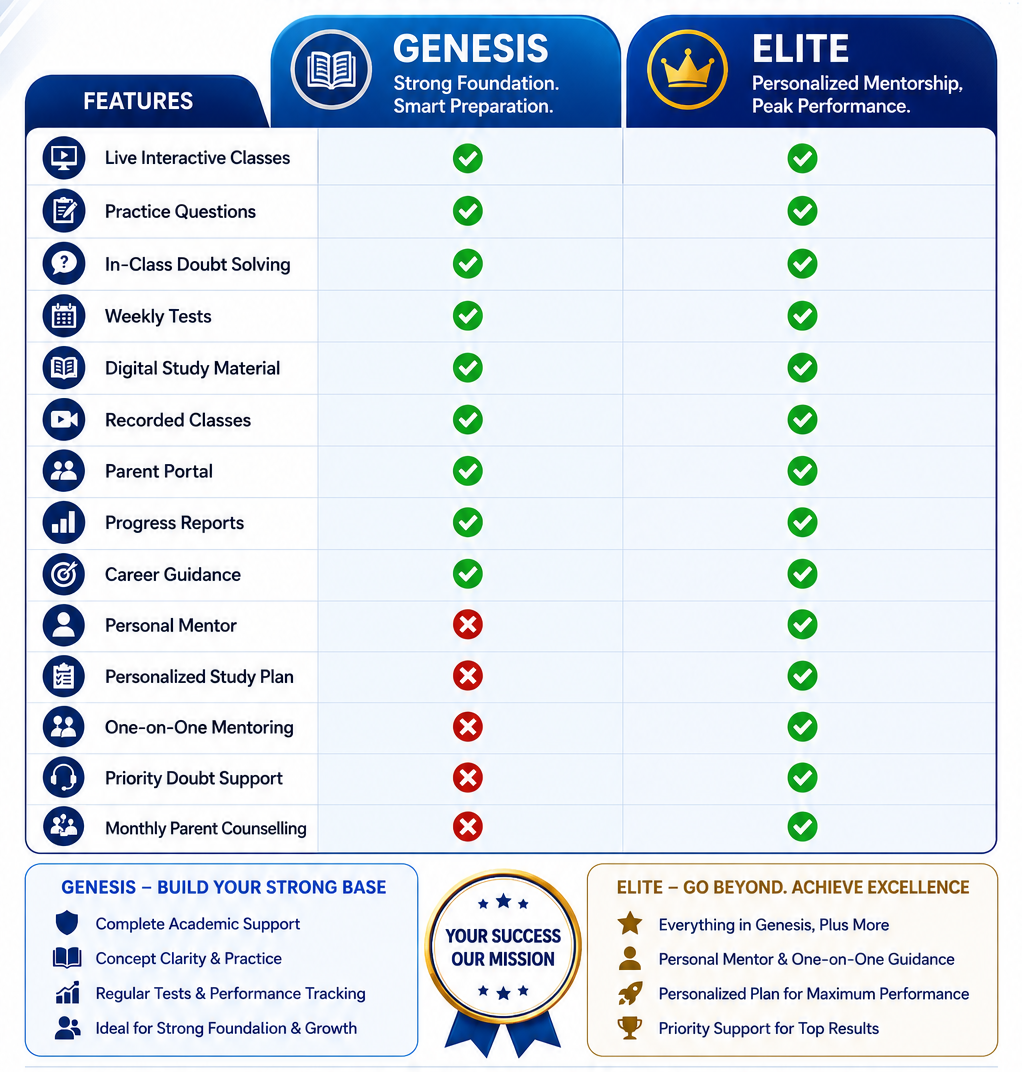
- Live Interactive Classes by Expert Faculty
- Live Discussion of Practice Questions
- Live In-Class Doubt Solving
- Live Quizzes & Performance Leaderboard
- Classroom-Like Learning Experience
- Small Batch Size for Better Attention
After Class
- Assignments & Class Notes
- Weekly/Monthly Test Series
- Digital Study Material
- Post-Class Doubt Support
- Student Progress Reports
- Parent Portal Access
- Parent-Teacher Meetings
- Handwritten Faculty Notes
- Chapter-wise Tests
- Unlimited Practice Worksheets
- Mock Tests with Discussion
- Career Guidance Sessions
🌟 Value Adds
- Personalized Learning Experience
- Regular Performance Tracking
- Free Career Guidance