- Description
- Curriculum
- FAQ
- Reviews
 To book a demo class, Click Here
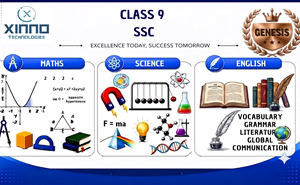
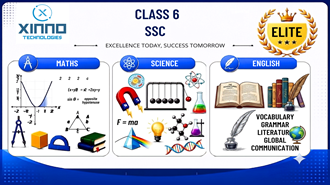
Subjects Covered: Mathematics, Science and English
SYLLABUS
MATHEMATICS
1. KNOWING OUR NUMBERS
Consolidating the sense of numberless up to 99,999 (five digits) – Estimation of numbers – Comparison of numbers – Place value (recapitulation and extension) – Use of symbols (=, <, >) – Word problems involving large numbers – Conversion of units of length and mass from larger units to smaller units – Estimation of outcomes of number operations – Introduction to large numbers up to lakhs, ten lakhs, crores and ten crores – Approximation of large numbers – International system of numeration (Millions) – Applications of large numbers in daily life situations.
2. WHOLE NUMBERS
Natural numbers and whole numbers – Properties of whole numbers including closure, commutative, associative and distributive properties – Additive identity and multiplicative identity – Division by zero – Number line representation – Addition, subtraction and multiplication on the number line – Pattern recognition and rule formulation – Applications of properties in arithmetic operations.
3. PLAYING WITH NUMBERS
Divisibility rules of 2, 3, 5, 6, 9 and 10 – Discovery of divisibility rules of 4, 8 and 11 through patterns – Multiples and factors – Prime numbers, composite numbers, co-prime numbers and twin prime numbers – Prime factorization – HCF and LCM using factorization and division methods – Property relating HCF and LCM.
4. INTEGERS
Introduction to negative numbers through real-life situations – Representation of integers on the number line – Comparison and ordering of integers – Addition and subtraction of integers – Understanding operations using the number line – Applications of integers in daily life.
5. FRACTIONS AND DECIMALS
Fractions as part of a whole and as division – Proper, improper and mixed fractions – Equivalent fractions – Representation of fractions on the number line – Comparison of fractions – Addition and subtraction of fractions – Decimal fractions – Place value in decimals – Conversion between fractions and decimals – Word problems involving money, length and mass.
6. ALGEBRA
Introduction to variables through patterns and word problems – Generalization of arithmetic patterns – Introduction to unknowns – Algebraic expressions – Simple equations – Solution of equations by trial and error – Applications in daily life situations.
7. RATIO AND PROPORTION
Concept of ratio – Comparison of quantities – Ratios involving different units – Division of quantities in a given ratio – Proportion as equality of ratios – Unitary method – Applications through word problems.
8. GEOMETRY
Basic geometrical ideas – Points, lines, line segments and rays – Angles and their types – Triangles, quadrilaterals and circles – Interior and exterior regions – Measurement of line segments and angles – Practical geometry and constructions – Perpendicular bisectors, angle bisectors and circles – Identification of 2D and 3D shapes – Symmetry and reflection.
9. MENSURATION
Perimeter of rectangles, squares and regular polygons – Understanding area – Area of rectangles and squares – Comparison of perimeter and area – Practical applications and word problems.
10. DATA HANDLING
Collection and organization of data – Recording data using tally marks and tables – Interpretation and construction of pictographs – Reading and drawing bar graphs – Use of scaling in pictographs.
SCIENCE
1. OUR FOOD: Different types of food materials – Food ingredients – Different sources of food materials (Plant parts and animal products) – People and food habits – Different methods of preparing food – Preservation of food.
2. PLAYING WITH MAGNETS: Why pins and metal objects stick to pin holders and iron almirahs – Magnets of different shapes (Bar, Ring, Horse Shoe, Disc) – Finding materials attracted by magnets – Separation by using magnets – Poles of bar magnet – Finding directions with a bar magnet – Earth as a magnet – Know about magnetic compass – Make your own compass – Magnetic attraction and repulsion – Finding whether an object is magnetic or not – Making your own magnet – Magnetic induction.
3. RAIN – WHERE DOES IT COME FROM: How we predict about rain – Water and its forms – Formation of clouds – Process of evaporation – Condensation – How clouds give rain – Clouds in kitchen – Monsoons – Water cycle.
4. WHAT DO ANIMALS EAT: How animals find food – Animal food habits (Herbivores, Carnivores, Omnivores) – From finding meal to eating it – Body parts used in taking food in hen, cow, dog, frog and others – Different types of beaks and food collection – Getting food using tongue – Hunting as a way of getting food – Filtering and sucking methods – Food chain – Animal colonies and food.
5. MATERIAL AND THINGS: Breakable and non-breakable objects – Materials used to make different objects – Objects made from different materials – Same material used for different objects – Properties of materials – Transparent and opaque objects – States of materials – Classification of materials (Solids, Liquids, Gases) – Sinking and insoluble substances in water.
6. HABITAT: Habitat as a place where organisms live – Organisms living under ground, on ground, in water and on water – Pond as habitat – Organisms living at different levels of a pond – Tree as habitat – Various levels of a tree suitable for organisms – House as habitat – Orchard as habitat – Terrestrial habitats – Aquatic habitats – Desert habitats – Diversity of habitats in Telugu States – Good habitat and good life – Conservation of habitats.
7. SEPARATION OF SUBSTANCES: Substances and mixtures – Components of natural and man-made mixtures – Hand picking – Winnowing – Sedimentation – Decantation – Sieving – Filtration – Crystallization – Distillation – Sublimation – Chromatography – Using water in separation of materials.
8. FIBRE TO FABRIC: Types of fabrics – Quality of fabrics – Fabrics in different seasons – Selection and priority of dress – Things made of fabric – Natural fibres – Artificial fibres – Characteristics of fibres – Ginning – Spinning – Making cotton yarn from cotton fibre – Weaving – Power looms – Hand looms – Making jute yarn – Characteristics of jute yarn – Mat making.
9. PLANTS: PARTS AND FUNCTIONS: Parts of plants – Identification of plant parts – Types of roots – Functions of roots – Absorption of water – Leaves – Venation – Types of venations – Functions of leaf – Observation of stomata – Transpiration – Stem support – Carrying food materials.
10. CHANGES AROUND US: Observation of changes – Milk changing into curd – Comparing milk and curd – Conditions for making curd – Changing seasons – Comparing duration of day in December and May – Sunrise directions in different seasons – Changes in shadows during winter and summer – Indicators and causes of change – Comparing milk-to-curd and seasonal changes – Categorising changes.
11. WATER IN OUR LIFE: Water and its uses – Measuring volume of water – Quantity of water – Daily water usage – Sources of water – Safe drinking water and its stages – Water on Earth – Wells – Drought and water scarcity – Effects of drought – Water wastage – Floods as a natural hazard.
12. SIMPLE ELECTRIC CIRCUITS: Cell – Bulb – Circuit – Simple electric circuit – Switch – Electric switch – Torch light – Conductors – Insulators – Story of the bulb.
13. LEARNING HOW TO MEASURE: Measurements in daily life – Measuring lengths – Story of scale – Measuring height – Measuring length accurately using meter scale – Precautions while using meter scale – Measuring thickness of thin objects – Measuring thickness of a coin – Measuring length of a curved path – Measurement of area – Standard units of area – Measuring area of regular surfaces – Measuring area of irregular surfaces – Measurement of volume – Measurement of volume of liquids – Measuring cylinder – Measuring volume of irregular solids using measuring cylinder.
14. MOVEMENTS IN ANIMALS: Human body and movement – Muscles – Touch your shoulder – Fold and unfold – How muscles work – Bones – Jaw bone – Clavicle – Ribs – Backbone – Pelvic girdle – Skull – Cartilage – Types of joints – Backbone as a spring – Ball and socket joint – Hinge joint – Neck joint – Fixed joints – Movement in animals – Locomotion in fish – Birds – Snake – Snail.
15. LIGHT, SHADOWS AND IMAGES: How we see objects – Formation of shadows – Guessing objects by shadows – Colour of shadows – Shape of shadows – Different shadows of the same object – Pinhole camera – Images with magnifying lens – Reflection of light.
16. LIVING AND NON-LIVING: Living and non-living things – Characteristics of living and non-living things – Movement – Food – Growth – Breathing – Waste removal – Reproduction – Oviparous and viviparous animals – Response to stimuli in Mimosa pudica – Response to light by earthworms – Seeds living or non-living – Prepare your own magnifier – Microscope – Compound microscope and parts – Bread mould – Microscopic organisms – Bacteria – Microorganisms in water.
ENGLISH
Unit 1. Peace and Harmony: A Reading: Peace and Harmony (Story) – Source: Young World, The Hindu – B Reading: I Want Peace (Poem) – C Reading: Grand Contest in the Forest (Story) – Vocabulary: Forms of Adjectives, Antonyms, Synonyms – Grammar: Adjectives, Adverbs of Frequency – Written Discourses: Invitation Card, Script for Compeering – Oral Discourses: Description, Compeering.
Unit 2. Heritage and Culture: A Reading: Telangana, The Pride of the People – B Reading: In the Bazaars of Hyderabad (Poem) by Sarojini Naidu – C Reading: Bammera Pothana, the Jewel of Telugu Literature (Biography) – Vocabulary: Adjectives – Grammar: Linkers (but, and, as well as, moreover, besides, not only…but also) – Written Discourses: Conversation – Oral Discourses: Description.
Unit 3. Faith: A Reading: What Can a Dollar and Eleven Cents Do? (Story) – B Reading: A Nation’s Strength (Poem) by Ralph Waldo Emerson – C Reading: Wilma Rudolph (Biography) – Vocabulary: Hospital Related Words, Spelling – Grammar: Possessive Forms, Contractions, Regular and Irregular Verbs, Quantifiers, Question Marks, Exclamation Marks – Written Discourses: Diary Entry, Letter – Oral Discourses: Role Play, Conversation.
Unit 4. Adventure and Imagination: A Reading: An Adventure Story – B Reading: The Naughty Boy (Poem) by John Keats – C Reading: Tanaji Malusare (Story) – Vocabulary: Collective Nouns, Verb to Noun Forms – Grammar: Direct and Indirect Speech – Written Discourses: Narrative, Poster – Oral Discourses: Description, News Report.
Unit 5. Environment: A Reading: Plant a Tree (Essay) – B Reading: If a Tree Could Talk (Poem) – C Reading: Children, Speak Up! (Speech) – Vocabulary: Furniture and Medicinal Plants – Grammar: If Clause – Written Discourses: Notice, Report Writing – Oral Discourses: Role Play, Description.
Unit 6. Travelogue: A Reading: Rip Van Winkle (Story) by Washington Irving – B Reading: My Shadow (Poem) by Robert Louis Stevenson – C Reading: Gulliver’s Travels (Story) – Vocabulary: Compound Adjectives – Grammar: Passive Voice, Adverbs of Frequency – Written Discourses: Narrative, Description – Oral Discourses: Description.
Unit 7. Games and Sports: A Reading: P.T. Usha, the Golden Girl (Biography) – B Reading: Indian Cricket Team (Poem) – C Reading: Ranji’s Wonderful Bat (Narrative) by Ruskin Bond – Vocabulary: Games and Sports Words, Synonyms – Grammar: Order of Adjectives, To-Infinitive – Written Discourses: Profile, Letter, Notice – Oral Discourses: Short Talk, Debate.
Unit 8. Wit and Humor: A Reading: Half the Price (Play) – B Reading: The Sheik’s White Donkey (Story) – Vocabulary: Linkers, Synonyms, Antonyms, Suffixes (-ful, -ment, -ness, -ing) – Grammar: Use of Must, Present Continuous Tense, WH Questions – Written Discourses: Letter – Oral Discourses: Role Play, Story.
Reading and revising lessons regularly.
Understanding concepts instead of memorizing.
Practicing worksheets, assignments, and sample papers.
Strengthening grammar, vocabulary, formulas, and scientific concepts.
Solving additional practice questions.
Asking doubts whenever needed.
Maintaining consistency and a positive attitude toward learning.
Building confidence and motivation.
Encouraging questions and curiosity.
Focusing on conceptual understanding rather than rote learning.
Providing interactive classroom sessions.
Giving regular assignments and practice exercises.
Conducting tests and performance evaluations.
Offering timely doubt-clearing support.
Helping students develop analytical and problem-solving skills.
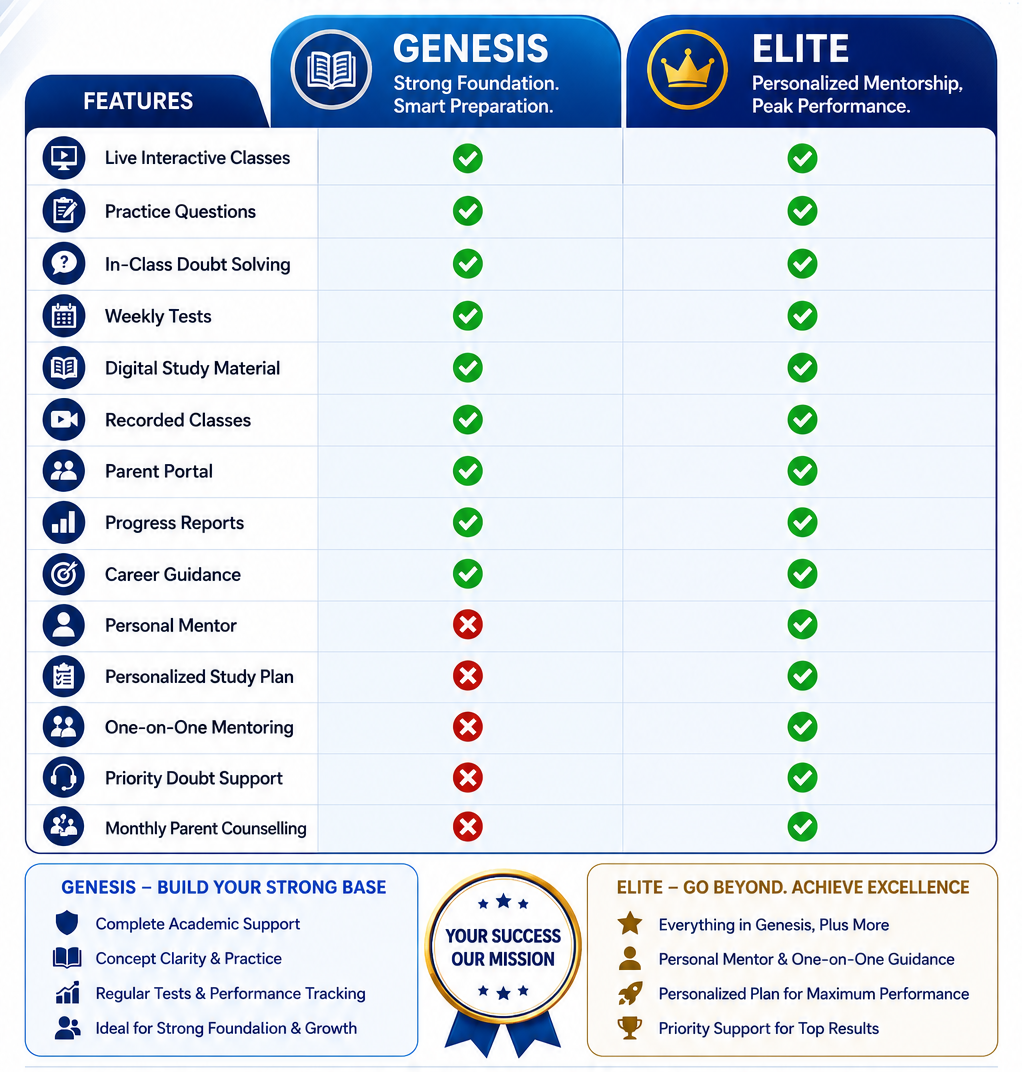
Elite
FEATURES
📚 Class
- Live Interactive Classes by Expert Faculty
- Live Discussion of Practice Questions
- Live In-Class Doubt Solving
- Live Quizzes & Performance Leaderboard
- Classroom-Like Learning Experience
- Very Small Batch Size for Better Attention
📖 After Class
- Assignments & Class Notes
- Weekly/Monthly Test Series
- Digital Study Material
- Post-Class Doubt Support
- Student Progress Reports
- Parent Portal Access
- Parent-Teacher Meetings
- Handwritten Faculty Notes
- Chapter-wise Tests
- Unlimited Practice Worksheets
- Mock Tests with Discussion
- Career Guidance Sessions
⭐ Premium Benefits
- Dedicated Personal Mentor
- One-on-One Doubt Solving Sessions
- Personalized Study Plan
- Individual Performance Analysis
- Monthly Parent Counselling
- Priority Doubt Resolution
- Exam Strategy Sessions
- Motivation & Mentorship Support
🌟 Value Adds
- Genesis Benefits Included
- Dedicated Personal Mentor
- Personalized Academic Guidance
- Priority Student Support
- Higher Success Tracking