- Description
- Curriculum
- FAQ
- Reviews
 To book a demo class, Click Here
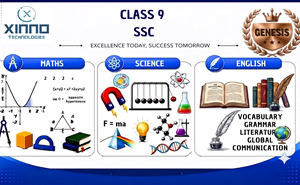
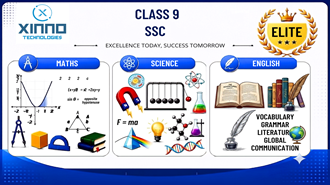
Subjects Covered: Mathematics, Science and English
SYLLABUS:
MATHEMATICS
1. REAL NUMBERS
Representation of natural numbers, integers and rational numbers on the number line – Terminating and recurring decimals – non-terminating and non-recurring decimals – Irrational numbers – Representation of irrational numbers on the number line – Surds and square roots – Rationalization of surds – Logarithms and their laws – Applications of logarithms.
2. SETS
Concept of sets – Empty sets, finite and infinite sets – Equal sets and subsets – Universal set – Cardinality of sets – Intervals of real numbers – Venn diagrams – Union, intersection and difference of sets – Applications of set theory.
3. POLYNOMIALS
Definition and types of polynomials – Monomials, binomials and trinomials – Zeroes of polynomials – Polynomial division – Remainder theorem – Factor theorem – Algebraic identities – Factorization of polynomials – Applications in algebra.
4. LINEAR EQUATIONS IN TWO VARIABLES
Introduction to equations in two variables – Graphical representation – Solutions by substitution and graphical methods – Graphs of straight lines – Lines parallel to axes – Word problems involving linear equations.
5. EUCLID’S GEOMETRY
History of Euclid and geometry – Definitions, axioms, postulates and theorems – Euclid’s five postulates – Relationship between axioms and theorems – Logical development of geometry.
6. GEOMETRY
Lines and angles – Parallel lines and transversals – Triangles and congruence criteria (SAS, ASA, SSS, RHS) – Properties of triangles – Quadrilaterals and parallelograms – Mid-point theorem – Area of parallelograms and triangles – Circles and their properties – Chords, arcs and angles – Cyclic quadrilaterals – Geometrical proofs and constructions.
7. COORDINATE GEOMETRY
Cartesian coordinate system – Coordinates of points – Plotting points on a plane – Understanding quadrants – Applications in graphing and geometry.
8. MENSURATION
Surface area and volume of cubes and cuboids – Surface area and volume of cylinders, cones, spheres and hemispheres – Relationship between surface area and volume – Word problems involving solid figures.
9. STATISTICS AND PROBABILITY
Frequency distributions – Mean, median and mode – Experimental probability – Random experiments – Tossing coins and dice – Notion of chance and randomness – Visualization of frequency distributions – Applications of probability in daily life.
SCIENCE
1. Cell Structure and Functions: Typical Cell – Plant and Animal Cell Comparison – Plasma Membrane – Cell Wall – Nucleus – Eukaryotic Cell – Prokaryotic Cell – Cytoplasm – Protoplasm – Endoplasmic Reticulum – Ribosomes – Lysosomes – Golgi Complex – Mitochondria – Vacuoles – Plastids – Chloroplasts – Are Cells Flat? – Origin of Cells.
2. Plant Tissues: Parts of Plants and Functions – Cells in Leaf and Onion Peel – Cells in Root Tip – Growing Roots in Onion – Meristematic Tissue – Dermal Tissue – Ground Tissue – Vascular Tissue – Apical Meristem – Lateral Meristem – Intercalary Meristem – Tissues in Dicot Stem – Epidermal Cells in Rheo Leaf – Parenchyma – Chlorenchyma – Aerenchyma – Storage Tissue – Sclerenchyma – Collenchyma – Xylem – Phloem.
3. Animal Tissues: Organ Systems and Functions – Observing Tissues – Blood Cells – Epithelial Tissue – Connective Tissue – Muscular Tissue – Nervous Tissue – Columnar – Cuboidal – Squamous Epithelium – Areolar Tissue – Adipose Tissue – Bone – Cartilage – Ligament – Tendon – Blood Tissue – RBC – WBC – Platelets – Granulocytes – Neutrophils – Basophils – Eosinophils – Agranulocytes – Lymphocytes – Monocytes – Blood Flow – Blood Clotting – Blood Groups – Universal Donor – Universal Acceptor.
4. Movement of Materials Across Cell Membrane: Entry and Exit of Substances – Solutions and Concentrations – Kishmish Experiment – Osmosis – Selectively Permeable Membrane – Filtration – Functions of Plasma Membrane – Flow Through Membrane – Importance of Osmosis – Diffusion.
5. Diversity in Living Organisms: Diversity in Plants and Animals – Monocots and Dicots – Human Variations – Classification – Need for Classification – Evolution of Life – Binomial Nomenclature – Five Kingdom Classification – Monera – Protista – Fungi – Plantae – Animalia – Classification of Plant Kingdom – Classification of Animal Kingdom.
6. Sense Organs: Stimulus and Response – Structure and Function of Eye – Eye Illusions – Eye Care – Eye Diseases – Structure of Ear – Hearing – Ear Care – Structure of Nose – Sense of Smell – Nose Care – Structure of Tongue – Taste Sensation – Tongue Care – Structure of Skin – Sense of Touch – Skin Diseases and Care.
7. Animal Behaviour: Animal Behaviour Types – Instinct – Imprinting – Conditioning – Imitation – Pavlov’s Experiment – Human Behaviour – Field and Laboratory Investigation – Tagging – Animal Intelligence.
8. Challenges in Improving Agricultural Products: Population Growth and Food Need – High Yielding Varieties – Irrigation Facilities – Water and Crop Yield – Plant Nutrients – Crop Rotation – Mixed Cropping – Organic Manure – Chemical Fertilizers – Soil Testing – Vermicompost – Panchagavya – Organic Farming – Long-Term Effects of Chemical Fertilizers – Crop Protection – Weeds – Plant Diseases – Pesticides.
9. Adaptations in Different Ecosystems: Ecosystems – Adaptations in Plants – Desert Ecosystem Adaptations – Aquatic Ecosystem Adaptations – Marine Ecosystem Adaptations – Swimming Adaptations – Euphotic Zone – Bathyal Zone – Abyssal Zone – Littoral Zone – Limnetic Zone – Profundal Zone – Salinity Adaptations – Hibernation – Aestivation – Symbiosis – Darwin’s Finches.
10. Soil Pollution: Soil and Its Properties – Physical – Chemical and Biological Properties – Soil Fertility – Soil Pollution – Biodegradable and Non-Biodegradable Wastes – Manures and Chemicals – Biomagnification – Solid Wastes – Deforestation – Urbanization – Underground Soil Pollution – Effects on Environment – Bioremediation – Soil Conservation.
11. Biogeochemical Cycles: Pollution and Ecosystem Cycles – Water Cycle – Nitrogen Fixation – Nitrification – Assimilation – Ammonification – Denitrification – Human Intervention in Nitrogen Cycle – Carbon Cycle – Photosynthesis – Carbon Fixation – Carbon Storage – Global Warming – Greenhouse Effect – Oxygen Cycle – Ozone Layer.
ENGLISH
Unit 1. Humor: A Reading: The Snake and the Mirror (Narrative) by Vaikom Muhammad Basheer – B Reading: The Duck and the Kangaroo (Poem) by Edward Lear – C Reading: Little Bobby (Letter) by Ritcha Rao – Vocabulary: Words Related to Sound, Linkers – Grammar: Phrasal Verbs, Combination of Simple Past and Past Perfect Tense – Written Discourses: Descriptive Essay, Poster – Oral Discourses: Speech, Choreography.
Unit 2. Games and Sports: A Reading: True Height (Story) by David Naster – B Reading: What Is a Player? (Poem) by Jessica Taylor – C Reading: V.V.S. Laxman, Very Very Special (Interview) from Sport star – Vocabulary: Synonyms, Collocations – Grammar: Adverbial Clauses with As, When, Since – Written Discourses: Biographical Sketch, Profile, Description – Oral Discourses: Speech, Conversation.
Unit 3. School Life: A Reading: Swami Is Expelled from School (Story) by R.K. Narayan – B Reading: Not Just a Teacher, but a Friend (Poem) – C Reading: Homework (Essay) – Vocabulary: Synonyms, Phrasal Verbs – Grammar: Direct and Indirect Speech, Noun Clauses – Written Discourses: Diary, Narrative, Notice, Report – Oral Discourses: Debate, Compeering.
Unit 4. Environment: A Reading: What Is Man Without the Beasts? (Speech) by Chief Seattle – B Reading: The River (Poem) by C.A. Bowles – C Reading: Can’t Climb Trees Any More (Story) by Ruskin Bond – Vocabulary: Words Related to Movement and Warmth – Grammar: Verb Phrase – Written Discourses: Speech, Report – Oral Discourses: Speech.
Unit 5. Disasters: A Reading: A Havoc of Flood (Report) – B Reading: Grabbing Everything on the Land (Poem) by Lily Usher – C Reading: The Ham Radio (Essay) from www.hamradio.in – Vocabulary: Same Word in Different Contexts, Flood Rescue Vocabulary – Grammar: Inversion of Adverbial Clauses Using No Sooner…Than, Scarcely…When – Written Discourses: Interview, Speech Script, Letter, Short Essay – Oral Discourses: Short Talk, Mock Interview.
Unit 6. Freedom: A Reading: A Long Walk to Freedom (Speech) by Nelson Mandela – B Reading: Where the Mind Is Without Fear (Poem) by Rabindranath Tagore – C Reading: An Icon of Civil Rights (Speech) by Martin Luther King Jr. – Vocabulary: Synonyms, Appropriate Forms of Words, Figurative Expressions – Grammar: Adjectival Clauses, Noun Phrases – Written Discourses: Essay, Speech – Oral Discourses: Debate.
Unit 7. Theatre: A Reading: The Trial (Play) by George Bernard Shaw – B Reading: Antony’s Speech (Poem Extract) by William Shakespeare – C Reading: Mahatma Gandhi, Pushed Out of Train Incident (Narrative) by Richard Briley – Vocabulary: Words Related to Church, Idioms Related to Tongue – Grammar: If Clauses – Written Discourses: Biographical Sketch, Invitation – Oral Discourses: Skit.
Unit 8. Travel and Tourism: A Reading: The Accidental Tourist (Narrative) by Bill Bryson – B Reading: Father Returning Home (Poem) by Dilip Chitre – C Reading: Kathmandu (Description) by Vikram Seth – Vocabulary: Compound Words, Homonyms, Words Related to Sounds – Grammar: Passive Voice – Written Discourses: Reply Letter – Oral Discourses: Description.
Reading and revising lessons regularly.
Understanding concepts instead of memorizing.
Practicing worksheets, assignments, and sample papers.
Strengthening grammar, vocabulary, formulas, and scientific concepts.
Solving additional practice questions.
Asking doubts whenever needed.
Maintaining consistency and a positive attitude toward learning.
Building confidence and motivation.
Encouraging questions and curiosity.
Focusing on conceptual understanding rather than rote learning.
Providing interactive classroom sessions.
Giving regular assignments and practice exercises.
Conducting tests and performance evaluations.
Offering timely doubt-clearing support.
Helping students develop analytical and problem-solving skills.

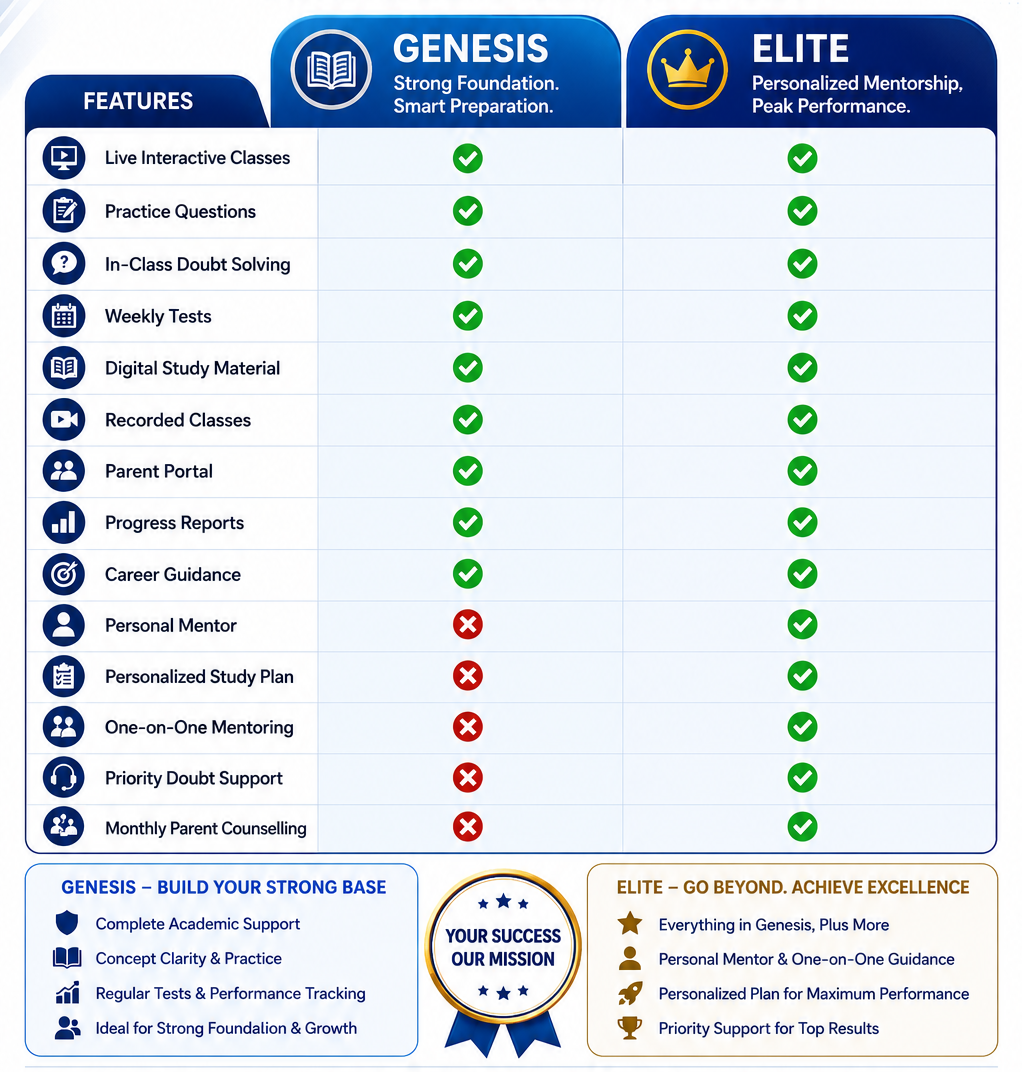
Elite
FEATURES
📚 Class
- Live Interactive Classes by Expert Faculty
- Live Discussion of Practice Questions
- Live In-Class Doubt Solving
- Live Quizzes & Performance Leaderboard
- Classroom-Like Learning Experience
- Very Small Batch Size for Better Attention
📖 After Class
- Assignments & Class Notes
- Weekly/Monthly Test Series
- Digital Study Material
- Post-Class Doubt Support
- Student Progress Reports
- Parent Portal Access
- Parent-Teacher Meetings
- Handwritten Faculty Notes
- Chapter-wise Tests
- Unlimited Practice Worksheets
- Mock Tests with Discussion
- Career Guidance Sessions
⭐ Premium Benefits
- Dedicated Personal Mentor
- One-on-One Doubt Solving Sessions
- Personalized Study Plan
- Individual Performance Analysis
- Monthly Parent Counselling
- Priority Doubt Resolution
- Exam Strategy Sessions
- Motivation & Mentorship Support
🌟 Value Adds
- Genesis Benefits Included
- Dedicated Personal Mentor
- Personalized Academic Guidance
- Priority Student Support
- Higher Success Tracking