- Description
- Curriculum
- FAQ
- Reviews
 To book a demo class, Click Here
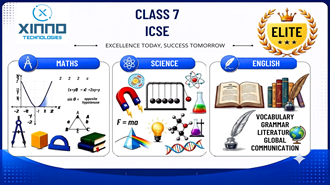
Subjects Covered: Mathematics, Science and English
SYLLABUS
MATHEMATICS
Unit–1: Number System
Integers – Closure property – Commutative property – Associative property – Distributive property – Word problems – Absolute value – Fractions – Decimals – Multiplication and division of fractions – Recurring decimals – Terminating decimals – Rational numbers – Number line representation – Standard form – Comparison of rational numbers.
Unit–2: Exponents and Powers
Base and exponent – Laws of exponents – Product law – Quotient law – Power law.
Unit–3: Ratio, Proportion and Commercial Arithmetic
Ratio – Proportion – Continued proportion – Unitary method – Direct variation – Inverse variation – Percentage – Increase and decrease percentage – Profit – Loss – Discount – Cost price – Selling price – Simple interest – Principal – Rate – Time – Amount.
Unit–4: Algebra
Algebraic expressions – Monomials – Binomials – Polynomials – Degree of expressions – Addition of expressions – Subtraction of expressions – Linear equations – Multi-step equations – Word problems.
Unit–5: Geometry
Lines and angles – Complementary angles – Supplementary angles – Adjacent angles – Vertically opposite angles – Parallel lines and transversals – Properties of triangles – Angle sum property – Exterior angle property – Triangle inequality theorem – Pythagoras theorem – Congruence of triangles – SSS – SAS – ASA – RHS criteria.
Unit–6: Mensuration
Perimeter – Surface area – Area of triangles – Area of parallelograms – Circumference of circle – Area of circle.
Unit–7: Data Handling
Arithmetic mean – Median – Mode – Double bar graphs – Interpretation of data.
SCIENCE
Unit–1: Physics
Basic concepts of Physics – Physical quantities – Measurement – Force – Motion – Energy – Heat – Light – Sound – Electricity – Magnetism.
Unit–2: Chemistry
Basic concepts of Chemistry – Matter – Elements – Compounds – Mixtures – Physical changes – Chemical changes – Acids – Bases – Salts – Separation techniques.
Unit–3: Biology
Living organisms – Cell structure – Plant life – Animal life – Human body systems – Nutrition – Respiration – Reproduction – Environment and ecology.
ENGLISH
Unit–1: Reading Comprehension
Complex prose passages – Classical poems – Critical analysis – Summarization – Complex inferences – Vocabulary in context.
Unit–2: Composition Writing
Multi-paragraph narrative compositions – Descriptive compositions – Argumentative compositions – Script writing – Dialogue writing – Picture composition.
Unit–3: Letter Writing
Formal letters – Letters to local authorities – Letters to editors – Business letters – School applications – Informal letters.
Unit–4: Grammar
Simple sentences – Compound sentences – Complex sentences – Transformation of phrases and clauses – Nouns – Pronouns – Relative pronouns – Interrogative pronouns – Indefinite pronouns – Articles – Adjectives – Degrees of comparison – Active voice – Passive voice – Finite verbs – Non-finite verbs – Infinitives – Gerunds – Participles – Subject-verb agreement – Perfect tense – Perfect continuous tense – Adverbs – Prepositions – Direct and indirect speech.
English Literature
Unit–1: Prose and Drama
Human resilience – Historical non-fiction – Socio-cultural themes – Dramatic texts – Character analysis – Contextual interpretation – Theme analysis.
Unit–2: Poetry
Alliteration – Onomatopoeia – Imagery – Hyperbole – Stanza-wise explanation – Theme analysis – Internal rhyme
Reading and revising lessons regularly.
Understanding concepts instead of memorizing.
Practicing worksheets, assignments, and sample papers.
Strengthening grammar, vocabulary, formulas, and scientific concepts.
Solving additional practice questions.
Asking doubts whenever needed.
Maintaining consistency and a positive attitude toward learning.
Building confidence and motivation.
Encouraging questions and curiosity.
Focusing on conceptual understanding rather than rote learning.
Providing interactive classroom sessions.
Giving regular assignments and practice exercises.
Conducting tests and performance evaluations.
Offering timely doubt-clearing support.
Helping students develop analytical and problem-solving skills.