- Description
- Curriculum
- FAQ
- Reviews
 To book a demo class, Click Here
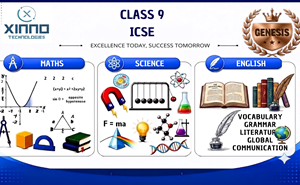
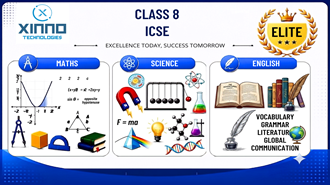
Subjects Covered: Mathematics, Science and English
SYLLABUS
MATHEMATICS
Unit–1: Number System
Rational numbers – Properties of rational numbers – Number line representation – Word problems – Exponents and powers – Laws of exponents – Squares – Square roots – Cubes – Cube roots.
Unit–2: Algebra
Algebraic expressions – Algebraic identities – (a + b)² – (a − b)² – (a + b)(a − b) – Factorization – Linear equations in one variable – Real-life applications.
Unit–3: Commercial Mathematics
Percentage – Profit – Loss – Discount – Simple interest – Compound interest – Direct variation – Inverse variation – Time and work.
Unit–4: Geometry
Quadrilaterals – Properties of quadrilaterals – Polygons – Interior angles – Exterior angles.
Unit–5: Mensuration
Area of trapezium – Area of polygons – Surface area of cube – Surface area of cuboid – Surface area of cylinder – Volume of cube – Volume of cuboid – Volume of cylinder.
Unit–6: Data Handling
Bar graphs – Histograms – Pie charts – Graphical representation of data – Introduction to probability.
SCIENCE
Unit–1: Matter and Measurement
Matter – Kinetic theory – Solids – Liquids – Gases – Physical quantities – Measurement – Density – Relative density – Floatation.
Unit–2: Force and Pressure
Force – Turning effect of force – Pressure – Atmospheric pressure – Thrust.
Unit–3: Energy
Work – Power – Kinetic energy – Potential energy – Forms of energy.
Unit–4: Light
Refraction – Spherical mirrors – Concave mirrors – Convex mirrors – Concave lenses – Convex lenses.
Unit–5: Heat
Conduction – Convection – Radiation – Heat transfer.
Unit–6: Sound
Propagation of sound – Characteristics of sound – Echo.
Unit–7: Electricity and Magnetism
Static electricity – Current electricity – Electrical safety – Magnetism – Magnetic fields.
Science (Chemistry)
Unit–1: Matter and Chemical Changes
Matter and its composition – Physical changes – Chemical changes – Elements – Compounds – Mixtures.
Unit–2: Atomic Structure
Atomic number – Mass number – Valency – Electronic configuration.
Unit–3: Language of Chemistry
Chemical symbols – Valency – Chemical formulae – Balancing chemical equations.
Unit–4: Chemical Reactions
Combination reactions – Decomposition reactions – Displacement reactions – Double displacement reactions.
Unit–5: Hydrogen
Preparation of hydrogen – Physical properties – Chemical properties – Uses of hydrogen.
Unit–6: Water
Hard water – Soft water – Water treatment – Water conservation.
Unit–7: Carbon and its Compounds
Allotropes of carbon – Carbon dioxide – Properties and uses of carbon compounds.
Science (Biology)
Unit–1: Transport in Plants
Xylem – Phloem – Transpiration – Transport mechanisms in plants.
Unit–2: Reproduction
Asexual reproduction – Sexual reproduction in plants – Sexual reproduction in animals.
Unit–3: Ecosystem
Biotic components – Abiotic components – Food chains – Food webs – Ecological relationships.
Unit–4: Human Body Systems
Endocrine system – Circulatory system – Nervous system – Functions and importance.
Unit–5: Health and Hygiene
Communicable diseases – Non-communicable diseases – Immunization – Preventive healthcare.
Unit–6: Food Production and Management
Agriculture – Crop production – Food management – Importance of food resources.
ENGLISH
Unit–1: Reading Comprehension
Unseen comprehension passages – Factual questions – Inferential questions – Vocabulary-based questions – Interpretation of passages.
Unit–2: Composition Writing
Narrative essays – Descriptive essays – Argumentative essays – Structured composition writing.
Unit–3: Letter and Email Writing
Formal letters – Informal letters – Notice writing – Email writing – Format and drafting skills.
Unit–4: Grammar
Tenses – Present tense – Past tense – Future tense – Active voice – Passive voice – Direct speech – Indirect speech – Phrases – Clauses – Prepositions – Conjunctions – Subject-verb agreement.
English Literature
Unit–1: Prose and Drama
Short stories – Character analysis – Plot interpretation – Theme analysis – Literary appreciation.
Unit–2: Poetry
Themes – Imagery – Tone – Central idea – Poetic appreciation and interpretation.
Reading and revising lessons regularly.
Understanding concepts instead of memorizing.
Practicing worksheets, assignments, and sample papers.
Strengthening grammar, vocabulary, formulas, and scientific concepts.
Solving additional practice questions.
Asking doubts whenever needed.
Maintaining consistency and a positive attitude toward learning.
Building confidence and motivation.
Encouraging questions and curiosity.
Focusing on conceptual understanding rather than rote learning.
Providing interactive classroom sessions.
Giving regular assignments and practice exercises.
Conducting tests and performance evaluations.
Offering timely doubt-clearing support.
Helping students develop analytical and problem-solving skills.