Intermediate 2 nd Year - Genesis

- Description
- Curriculum
- FAQ
- Reviews
 To book a demo class, Click Here
Subjects Covered: Mathematics, Physics and Chemistry
MATHEMATICS IIA SYLLABUS
Unit 1: Complex Numbers
Complex Numbers as Ordered Pairs of Real Numbers – Fundamental Operations – Representation in the form a + ib – Modulus and Amplitude – Geometrical and Polar Representation – Argand Plane and Argand Diagram.
Unit 2: De Moivre’s Theorem
De Moivre’s Theorem for Integral and Rational Indices – nth Roots of Unity – Geometrical Interpretations and Applications.
Unit 3: Quadratic Expressions
Quadratic Expressions – Quadratic Equations in One Variable – Sign of Quadratic Expressions – Change of Signs – Maximum and Minimum Values – Quadratic Inequalities.
Unit 4: Theory of Equations
Relations Between Roots and Coefficients – Equations with Related Roots – Equations with Real Coefficients – Complex Conjugate Roots – Transformation of Equations – Reciprocal Equations.
Unit 5: Permutations and Combinations
Fundamental Principle of Counting – Linear and Circular Permutations – Permutations of n Dissimilar Objects – Permutations with Repetition – Combinations and Related Theorems.
Unit 6: Binomial Theorem
Binomial Theorem for Positive Integral Index – Binomial Theorem for Rational Index – Approximations Using Binomial Theorem.
Unit 7: Partial Fractions
Partial Fractions with Non-Repeated Linear Factors – Repeated Linear Factors – Irreducible Quadratic Factors.
Unit 8: Measures of Dispersion
Range – Mean Deviation – Variance – Standard Deviation – Coefficient of Variation – Analysis of Frequency Distributions.
Unit 9: Probability
Random Experiments and Events – Classical Definition of Probability – Axiomatic Approach – Addition Theorem – Independent and Dependent Events – Conditional Probability – Multiplication Theorem – Bayes’ Theorem.
Unit 10: Random Variables and Probability Distributions
Random Variables – Binomial Distribution – Poisson Distribution.
MATHEMATICS IIB SYLLABUS
Unit 1: Circle
Equation of Circle – Centre and Radius – Circle Through Three Non-Collinear Points – Parametric Equations – Position of a Point Relative to a Circle – Power of a Point – Tangents and Normals – Chord of Contact – Pole and Polar – Conjugate Points and Lines – Relative Position of Two Circles – Common Tangents – Centres of Similitude.
Unit 2: System of Circles
Angle Between Two Intersecting Circles – Radical Axis – Common Chord – Common Tangent – Radical Centre – Intersection of a Line and Circle.
Unit 3: Parabola
Conic Sections – Standard Equation of Parabola – Different Forms of Parabola – Parametric Equations – Tangents and Normals – Conditions for Tangency.
Unit 4: Ellipse
Standard Equation of Ellipse – Parametric Equations – Tangents and Normals – Conditions for Tangency.
Unit 5: Hyperbola
Standard Equation of Hyperbola – Parametric Equations – Tangents and Normals – Conditions for Tangency – Asymptotes.
Unit 6: Integration
Integration as the Inverse Process of Differentiation – Standard Integrals – Properties of Integrals – Substitution Method – Integration by Parts – Partial Fractions Method – Reduction Formulae.
Unit 7: Definite Integrals
Definite Integral as Limit of Sum – Area Interpretation – Fundamental Theorem of Integral Calculus – Properties – Reduction Formulae – Applications to Area.
Unit 8: Differential Equations
Formation of Differential Equations – Degree and Order – Variable Separable Method – Homogeneous Differential Equations – Non-Homogeneous Differential Equations – Linear Differential Equations.
PHYSICS SYLLABUS
Unit 1: Waves
Transverse and Longitudinal Waves – Progressive Waves – Wave Speed – Principle of Superposition – Reflection of Waves – Beats – Doppler Effect.
Unit 2: Ray Optics and Optical Instruments
Reflection by Spherical Mirrors – Refraction – Total Internal Reflection – Refraction Through Lenses and Prisms – Dispersion – Optical Phenomena Due to Sunlight – Optical Instruments.
Unit 3: Wave Optics
Huygens Principle – Reflection and Refraction Using Huygens Principle – Coherent and Incoherent Waves – Interference – Young’s Double Slit Experiment – Diffraction – Polarisation.
Unit 4: Electric Charges and Fields
Electric Charges – Conductors and Insulators – Charging by Induction – Coulomb’s Law – Electric Field – Electric Flux – Electric Dipole – Gauss’s Law and Applications.
Unit 5: Electrostatic Potential and Capacitance
Electrostatic Potential – Potential Due to Charges and Dipoles – Equipotential Surfaces – Potential Energy – Electrostatics of Conductors – Dielectrics – Capacitors – Combination of Capacitors – Energy Stored in Capacitors – Van de Graaff Generator.
Unit 6: Current Electricity
Electric Current – Ohm’s Law – Drift Velocity – Resistivity – Electric Power – Series and Parallel Resistors – Cells and Internal Resistance – Kirchhoff’s Laws – Wheatstone Bridge – Meter Bridge – Potentiometer.
Unit 7: Moving Charges and Magnetism
Magnetic Force – Motion in Magnetic Fields – Biot-Savart Law – Ampere’s Circuital Law – Solenoid and Toroid – Torque on Current Loop – Moving Coil Galvanometer.
Unit 8: Magnetism and Matter
Bar Magnet – Earth’s Magnetism – Magnetisation – Magnetic Intensity – Magnetic Properties of Materials – Electromagnets.
Unit 9: Electromagnetic Induction
Faraday’s Laws – Lenz’s Law – Motional EMF – Eddy Currents – Inductance – AC Generator.
Unit 10: Alternating Current
AC Through Resistor, Inductor and Capacitor – LCR Circuits – Power Factor – LC Oscillations – Transformers.
Unit 11: Electromagnetic Waves
Displacement Current – Electromagnetic Waves – Electromagnetic Spectrum.
Unit 12: Dual Nature of Radiation and Matter
Photoelectric Effect – Einstein’s Photoelectric Equation – Photon Concept – Wave Nature of Matter – Davisson-Germer Experiment.
Unit 13: Atoms
Rutherford Model – Atomic Spectra – Bohr Model – Hydrogen Spectrum – Quantisation of Angular Momentum.
Unit 14: Nuclei
Composition of Nucleus – Nuclear Size – Binding Energy – Nuclear Forces – Radioactivity – Nuclear Energy.
Unit 15: Semiconductor Electronics
Intrinsic and Extrinsic Semiconductors – p-n Junction – Diodes – Rectifiers – Junction Transistors – Logic Gates – Integrated Circuits.
Unit 16: Communication Systems
Elements of Communication Systems – Bandwidth – Propagation of Electromagnetic Waves – Modulation – Amplitude Modulation – Detection of Modulated Waves.
CHEMISTRY SYLLABUS
Unit 1: Solid State
General Characteristics of Solids – Amorphous and Crystalline Solids – Classification of Crystalline Solids – X-ray Crystallography – Crystal Lattices and Unit Cells – Number of Atoms in a Unit Cell – Close Packed Structures – Packing Efficiency – Calculations Involving Unit Cell Dimensions – Imperfections in Solids – Electrical Properties – Magnetic Properties.
Unit 2: Solutions
Types of Solutions – Concentration of Solutions – Solubility – Vapour Pressure of Liquid Solutions – Ideal and Non-Ideal Solutions – Colligative Properties – Determination of Molar Mass – Abnormal Molar Masses.
Unit 3: Electrochemistry and Chemical Kinetics
Electrochemical Cells – Galvanic Cells – Nernst Equation – Conductance of Electrolytic Solutions – Electrolytic Cells and Electrolysis – Batteries – Fuel Cells – Corrosion – Rate of Chemical Reactions – Factors Affecting Reaction Rate – Integrated Rate Equations – Pseudo First Order Reactions – Temperature Dependence of Reaction Rates – Collision Theory.
Unit 4: Surface Chemistry
Adsorption – Catalysis – Colloids – Classification of Colloids – Emulsions – Colloids Around Us.
Unit 5: General Principles of Metallurgy
Occurrence of Metals – Concentration of Ores – Extraction of Crude Metals – Thermodynamic Principles of Metallurgy – Electrochemical Principles of Metallurgy – Oxidation and Reduction – Refining of Metals – Uses of Aluminium, Copper, Zinc and Iron.
Unit 6: p-Block Elements
Group 15: Dinitrogen – Ammonia – Oxides of Nitrogen – Nitric Acid – Phosphorus and its Allotropes – Phosphine – Phosphorus Halides – Oxoacids of Phosphorus.
Group 16: Dioxygen – Oxides – Ozone – Sulphur and its Allotropes – Sulphur Dioxide – Oxoacids of Sulphur – Sulphuric Acid.
Group 17: Chlorine – Hydrogen Chloride – Oxoacids of Halogens – Interhalogen Compounds.
Group 18: Noble Gases – Occurrence – Electronic Configuration – Physical and Chemical Properties.
Unit 7: d and f Block Elements & Coordination Compounds
Transition Elements – Electronic Configuration – Properties of d-Block Elements – Important Compounds – Inner Transition Elements – Actinoids – Applications of d and f Block Elements – Werner’s Theory – Nomenclature of Coordination Compounds – Isomerism – Bonding – Metal Carbonyls – Stability and Applications of Coordination Compounds.
Unit 8: Polymers
Classification of Polymers – Polymerization Reactions – Molecular Mass of Polymers – Biodegradable Polymers – Commercially Important Polymers.
Unit 9: Biomolecules
Carbohydrates – Proteins – Enzymes – Vitamins – Nucleic Acids – Hormones.
Unit 10: Chemistry in Everyday Life
Drugs and their Classification – Drug-Target Interaction – Therapeutic Action of Drugs – Chemicals in Food – Cleansing Agents.
Unit 11: Haloalkanes and Haloarenes
Classification – Nature of C–X Bond – Methods of Preparation – Physical Properties – Chemical Reactions – Polyhalogen Compounds.
Unit 12: Organic Compounds Containing C, H and O
Alcohols, Phenols and Ethers: Classification – Nomenclature – Structure – Physical and Chemical Properties – Commercially Important Alcohols – Ethers.
Aldehydes and Ketones: Nomenclature – Structure – Preparation – Physical and Chemical Properties – Uses.
Carboxylic Acids: Nomenclature – Structure – Preparation – Physical and Chemical Properties – Uses.
Unit 13: Organic Compounds Containing Nitrogen
Amines – Structure – Classification – Nomenclature – Preparation – Physical and Chemical Properties.
Diazonium Salts – Preparation – Properties – Reactions – Synthetic Applications.
Cyanides and Isocyanides – Structure and Preparation.
• Understanding concepts thoroughly instead of memorizing formulas.
• Practicing numerical problems, worksheets, and assignments regularly.
• Solving previous year question papers and mock tests.
• Developing logical thinking and analytical problem-solving skills.
• Relating theoretical concepts to practical and real-world applications.
• Revising important topics consistently.
• Maintaining a positive attitude and disciplined study routine.
• Building confidence through personalized guidance.
• Encouraging curiosity and critical thinking.
• Focusing on conceptual understanding rather than rote learning.
• Conducting interactive classroom sessions.
• Providing regular assignments and practice exercises.
• Conducting weekly tests and performance evaluations.
• Offering timely doubt-clearing support.
• Helping students develop strong analytical and problem-solving abilities.
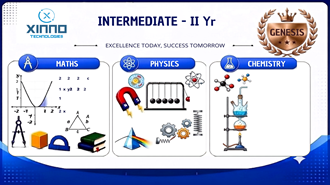
Genesis
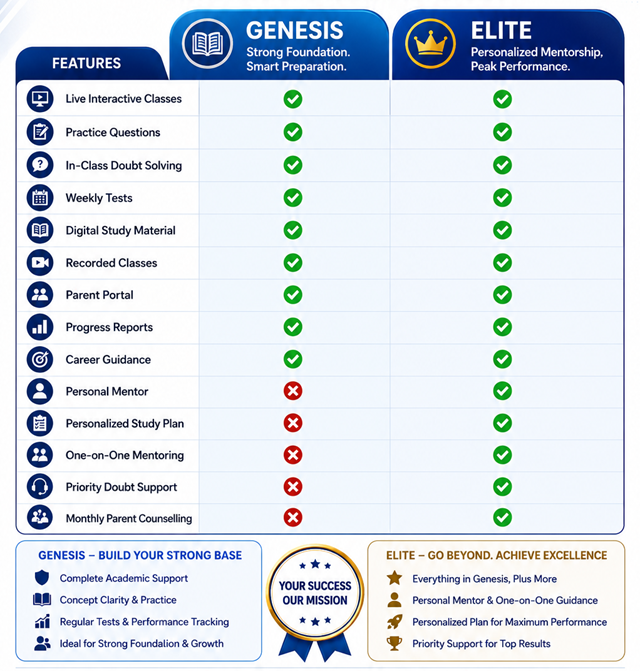
FEATURES
📚 Class
- Live Interactive Classes by Expert Faculty
- Live Discussion of Practice Questions
- Live In-Class Doubt Solving
- Live Quizzes & Performance Leaderboard
- Classroom-Like Learning Experience
- Small Batch Size for Better Attention
After Class
- Assignments & Class Notes
- Weekly/Monthly Test Series
- Digital Study Material
- Post-Class Doubt Support
- Student Progress Reports
- Parent Portal Access
- Parent-Teacher Meetings
- Handwritten Faculty Notes
- Chapter-wise Tests
- Unlimited Practice Worksheets
- Mock Tests with Discussion
- Career Guidance Sessions
🌟 Value Adds
- Personalized Learning Experience
- Regular Performance Tracking
- Free Career Guidance