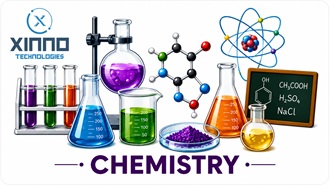
Intermediate 2nd Year Chemistry

- Description
- Curriculum
- FAQ
- Reviews
 To book a demo class, Click Here
SYLLABUS
Unit 1: Solid State
General Characteristics of Solids – Amorphous and Crystalline Solids – Classification of Crystalline Solids – X-ray Crystallography – Crystal Lattices and Unit Cells – Number of Atoms in a Unit Cell – Close Packed Structures – Packing Efficiency – Calculations Involving Unit Cell Dimensions – Imperfections in Solids – Electrical Properties – Magnetic Properties.
Unit 2: Solutions
Types of Solutions – Concentration of Solutions – Solubility – Vapour Pressure of Liquid Solutions – Ideal and Non-Ideal Solutions – Colligative Properties – Determination of Molar Mass – Abnormal Molar Masses.
Unit 3: Electrochemistry and Chemical Kinetics
Electrochemical Cells – Galvanic Cells – Nernst Equation – Conductance of Electrolytic Solutions – Electrolytic Cells and Electrolysis – Batteries – Fuel Cells – Corrosion – Rate of Chemical Reactions – Factors Affecting Reaction Rate – Integrated Rate Equations – Pseudo First Order Reactions – Temperature Dependence of Reaction Rates – Collision Theory.
Unit 4: Surface Chemistry
Adsorption – Catalysis – Colloids – Classification of Colloids – Emulsions – Colloids Around Us.
Unit 5: General Principles of Metallurgy
Occurrence of Metals – Concentration of Ores – Extraction of Crude Metals – Thermodynamic Principles of Metallurgy – Electrochemical Principles of Metallurgy – Oxidation and Reduction – Refining of Metals – Uses of Aluminium, Copper, Zinc and Iron.
Unit 6: p-Block Elements
Group 15: Dinitrogen – Ammonia – Oxides of Nitrogen – Nitric Acid – Phosphorus and its Allotropes – Phosphine – Phosphorus Halides – Oxoacids of Phosphorus.
Group 16: Dioxygen – Oxides – Ozone – Sulphur and its Allotropes – Sulphur Dioxide – Oxoacids of Sulphur – Sulphuric Acid.
Group 17: Chlorine – Hydrogen Chloride – Oxoacids of Halogens – Interhalogen Compounds.
Group 18: Noble Gases – Occurrence – Electronic Configuration – Physical and Chemical Properties.
Unit 7: d and f Block Elements & Coordination Compounds
Transition Elements – Electronic Configuration – Properties of d-Block Elements – Important Compounds – Inner Transition Elements – Actinoids – Applications of d and f Block Elements – Werner’s Theory – Nomenclature of Coordination Compounds – Isomerism – Bonding – Metal Carbonyls – Stability and Applications of Coordination Compounds.
Unit 8: Polymers
Classification of Polymers – Polymerization Reactions – Molecular Mass of Polymers – Biodegradable Polymers – Commercially Important Polymers.
Unit 9: Biomolecules
Carbohydrates – Proteins – Enzymes – Vitamins – Nucleic Acids – Hormones.
Unit 10: Chemistry in Everyday Life
Drugs and their Classification – Drug-Target Interaction – Therapeutic Action of Drugs – Chemicals in Food – Cleansing Agents.
Unit 11: Haloalkanes and Haloarenes
Classification – Nature of C–X Bond – Methods of Preparation – Physical Properties – Chemical Reactions – Polyhalogen Compounds.
Unit 12: Organic Compounds Containing C, H and O
Alcohols, Phenols and Ethers: Classification – Nomenclature – Structure – Physical and Chemical Properties – Commercially Important Alcohols – Ethers.
Aldehydes and Ketones: Nomenclature – Structure – Preparation – Physical and Chemical Properties – Uses.
Carboxylic Acids: Nomenclature – Structure – Preparation – Physical and Chemical Properties – Uses.
Unit 13: Organic Compounds Containing Nitrogen
Amines – Structure – Classification – Nomenclature – Preparation – Physical and Chemical Properties.
Diazonium Salts – Preparation – Properties – Reactions – Synthetic Applications.
Cyanides and Isocyanides – Structure and Preparation.
• Grasping the underlying concepts, molecular structures, and chemical reactions clearly, rather than relying solely on rote formula memorization.
• Practicing balancing equations and solving numerical problems regularly.
• Connecting abstract molecular behavior to everyday real-world phenomena and laboratory applications.
• Maintaining a positive, systematic attitude when mastering periodic trends and complex mechanisms.