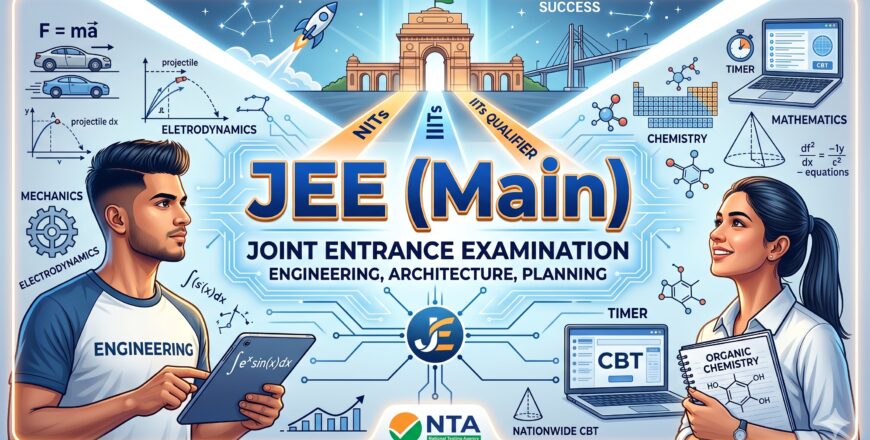
JEE (Main)
JEE (Main), or the Joint Entrance Examination (Main), is a premier national-level standardized test in India conducted by the National Testing Agency (NTA). Taken by over a million students annually after completing high school (Class 12), it serves two distinct purposes:
- Direct Admission: It is the sole gateway for admission to undergraduate engineering and architecture programs (B.E. / B.Tech, B.Arch, and B.Planning) across prestigious premier institutes like the National Institutes of Technology (NITs), Indian Institutes of Information Technology (IIITs), and other Centrally Funded Technical Institutes (CFTIs).
- Eligibility Screening: It acts as the screening prerequisite to qualify for JEE (Advanced)—the highly exclusive exam required to get into the Indian Institutes of Technology (IITs). Only the top ~250,000 score-holders from JEE (Main) are permitted to attempt JEE (Advanced).

-
2
 Nvidia New Technologies Slides
Welcome to your first slider tutorial. This slides will start with a simple introduction. Then, You will open up google cause I"ll show you where you can download the blender software and which version of it will we be using in the entire course period.
Note: The download link is available with the lecture, plus the .pdf file is also included for you to download if you still need help downloading the software.
-
3
Engine Target Audience
-
4
 Quiz: Mobile / Native Apps
 -
5
Uploaded Lesson Material
-
6
Sample Text Lesson
-
7
 Realistic Graphic on UE4
 -
8
Volta GPU for optimization.
The Tensor Core GPU Architecture designed to Bring AI to Every Industry. Equipped with 640 Tensor Cores, Volta delivers over 100 teraflops per second (TFLOPS) of deep learning performance, over a 5X increase compared to prior generation NVIDIA Pascal architecture.
-
9
Deep Learning
JEE (Main), or the Joint Entrance Examination (Main), is a premier national-level standardized test in India conducted by the National Testing Agency (NTA). Taken by over a million students annually after completing high school (Class 12), it serves two distinct purposes:
- Direct Admission: It is the sole gateway for admission to undergraduate engineering and architecture programs (B.E. / B.Tech, B.Arch, and B.Planning) across prestigious premier institutes like the National Institutes of Technology (NITs), Indian Institutes of Information Technology (IIITs), and other Centrally Funded Technical Institutes (CFTIs).
- Eligibility Screening: It acts as the screening prerequisite to qualify for JEE (Advanced)—the highly exclusive exam required to get into the Indian Institutes of Technology (IITs). Only the top ~250,000 score-holders from JEE (Main) are permitted to attempt JEE (Advanced).
Exam Structure & Mode
The entire examination is a Computer Based Test (CBT), where students sit at designated test centers and interact with an on-screen console.
The exam is split into three separate papers based on what course you intend to pursue:
- Paper 1: For B.E. / B.Tech courses (Most common path, testing Physics, Chemistry, and Mathematics).
- Paper 2A: For B.Arch (Architecture).
- Paper 2B: For B.Planning.
Paper 1 (B.Tech) Pattern & Marking Scheme
For core engineering aspirants, Paper 1 is structured out of 300 total marks and must be completed in exactly 3 hours.
Question Distribution per Subject
Each of the three sections (Physics, Chemistry, and Math) follows an identical distribution pattern:
- Section A (20 MCQs): Standard multiple-choice questions with 4 options and only 1 correct answer. All 20 are compulsory.
- Section B (10 Numerical Value Questions): Questions where the final answer is a specific numerical value you enter using an on-screen virtual keyboard. Candidates only need to attempt any 5 out of these 10.
The Marking Protocol
The NTA enforces a strict marking rule across both sections to discourage blind guessing:
- Correct Answer: +4 marks
- Incorrect Answer: -1 mark (Negative marking applies to both MCQs and Numerical questions)
- Unanswered/Marked for Review: 0 marks
Eligibility Criteria Basics
- Age Limit: There is no upper age limit specified by the NTA to take the test.
- Academic Window: Candidates can sit for the exam during the year they pass their Class 12 (or equivalent) exams, and in the immediate two consecutive years following it (a maximum window of 3 consecutive years).
- Admission Threshold: While anyone meeting the criteria can sit for the test, actual admission into an NIT, IIIT, or CFTI requires securing at least 75% marks in the Class 12 board examination (or being in the top 20 percentile of their respective board). For SC/ST candidates, this requirement is relaxed to 65%.